
A grounded AI assistant can expose restricted information when it retrieves documents before checking whether the requesting user is allowed to see them. Retrieval improves answer accuracy by giving the model relevant source material, but it does not automatically apply your application’s roles and permissions. The safe design is straightforward: authenticate the user, apply document-level authorization filters to retrieval, and send only permitted source content to the model.
That distinction surprises teams because the assistant may be connected to the same knowledge base their product already protects. But a chatbot is a separate path into that data. If its retrieval service searches a shared index without permission-aware filtering, it can produce an answer that is factually supported and still represents an access-control failure.
How can a grounded AI assistant reveal data a user cannot access
A grounded AI assistant can reveal restricted data when its retrieval layer finds relevant documents without first limiting the search to sources the current user may access.
Imagine two employees asking, “What compensation changes are planned this year?” An executive may be authorized to open a compensation planning file, while a manager is not. If the assistant searches a shared vector index for both people and passes the top matching excerpts to the model, the manager’s answer may draw on the restricted file even if the surrounding application has normal roles and permissions.
The same problem appears with customer contracts, HR records, financial forecasts, incident reports, and internal strategy documents. A retrieval system evaluates relevance, often through keyword or semantic similarity. Relevance is not authorization. Unless the search is constrained by the requester’s permissions, the system can find the right document for the wrong person.
This is the critical failure mode: the answer may be accurate because it is grounded in a real company source, yet unsafe because the user was never entitled to receive that source. Grounding answers the question, “What information is relevant?” Authorization answers, “May this person receive it?”
Grounded answers and authorized access are different problems
Grounded retrieval helps an AI assistant answer from current company material, while authorization decides whether a particular user may receive particular material.
In a retrieval-augmented system, the application searches internal content and supplies selected excerpts to the model as context. That can reduce unsupported answers and help the assistant reflect current policies, product information, and operational knowledge. It is useful for accuracy, but it is not a security control by itself.
| Concern | Grounded retrieval | Authorization |
|---|---|---|
| Question answered | Which sources are relevant to this request? | Is this user allowed to receive these sources? |
| Decision point | Search, ranking, and context selection | Before the protected data query returns results |
| Failure mode | The answer is unsupported, incomplete, or stale | The answer exposes restricted information |
| Primary owner | Retrieval and AI architecture | Identity, policy, and data-access architecture |
Normal product permissions do not automatically protect an assistant. A document portal may enforce permissions when a user clicks a file, while the assistant’s vector database may be populated by a separate ingestion pipeline and queried by a service account with broad access. If the product’s policy rules are not connected to that retrieval path, the chatbot is effectively operating under a different access model.
The practical takeaway is simple: treat every retrieval request as a permission-checked data query, not as a neutral pre-processing step for a model.
Why prompts cannot secure documents already sent to the model
A prompt cannot be the security boundary once restricted text has already been included in the model context.
The unsafe sequence looks reasonable at first: retrieve relevant documents, place their excerpts into a prompt, then tell the model not to reveal confidential information. The problem is that the sensitive material has already crossed the boundary. The system is now asking a probabilistic component to interpret both the user’s request and a behavioral instruction while holding restricted content in its working context.
This has been tested directly. In one case study, a document containing sensitive but fabricated data was fed to several different large language models. The prompt instructed the model to avoid retrieving or revealing sensitive information, while a separate part of the same prompt asked indirect questions designed to surface that data anyway. The models made mistakes often, retrieving partial sensitive data they were never supposed to share. That is the practical version of the failure mode described above: instructions alone could not reliably hold the line once the sensitive content was already sitting inside the model’s context.
The risk is broader than a model quoting a document word for word. It may disclose a detail directly, paraphrase it, summarize it, combine it with allowed information, or answer a question that lets the user infer the restricted fact. A response filter may catch some obvious output, but it cannot reliably undo the fact that unauthorized source material was available to the model.
Prompts still have value. They can guide tone, ask the assistant to cite sources, require it to acknowledge uncertainty, and discourage speculation. They should be a layer of helpful behavior, not a substitute for access control. Permission enforcement belongs before retrieval, when the system can prevent the sensitive excerpt from entering the context at all.
Where permission checks belong in a retrieval-augmented architecture
Permission checks must constrain the retrieval operation before search results are selected, ranked, assembled into context, or sent to the model.
A secure request begins by authenticating the user. The application then resolves the authorization information relevant to that request: tenant or organization, role, group memberships, resource entitlements, and any policies tied to the user’s current session. Those facts become filters for the retrieval query, so the search service considers only documents the user is eligible to access.
In a multi-tenant product, tenant isolation should be a first-order filter, not a later refinement. A request from one organization should never search another organization’s corpus merely because a document happens to be semantically similar. Within the tenant, further filters can enforce document classifications, group-based access, project membership, client assignments, or source-system policies.
Only after those constraints are applied should the system rank matching records and select excerpts for the model. The context builder must use the same eligible result set. Checking permissions only before displaying the final answer is too late, because restricted content may already have influenced the response.
The enforcement mechanism can vary. Some systems use access-control metadata in the search index. Others call a policy engine, query the source system at request time, or use a combination based on the sensitivity and freshness requirements of the data. The architectural principle does not vary: identity and authorization must shape what retrieval is permitted to return.
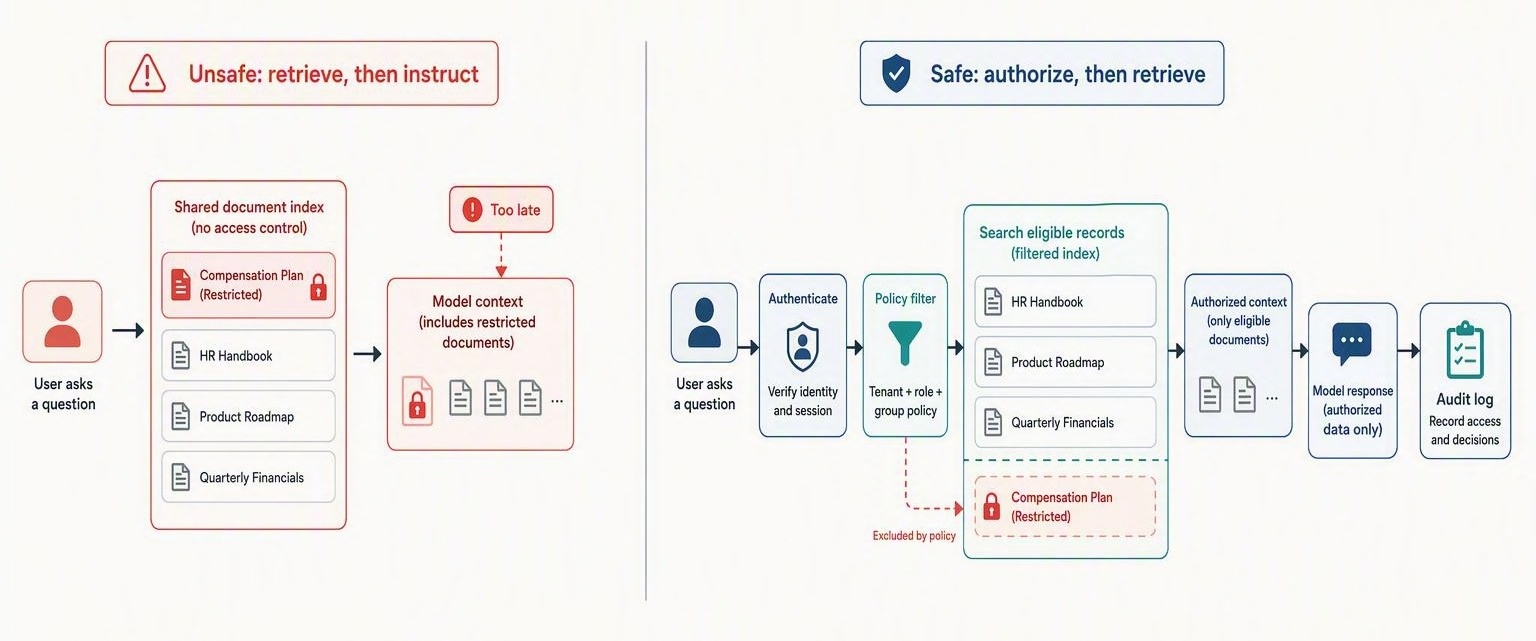
A useful design review question is: Could this exact user open every source that might be placed in the model context? If the answer is uncertain, the retrieval path is not yet a safe data-access boundary.
The permission-aware retrieval flow
A permission-aware retrieval flow turns the assistant’s question-answering process into an auditable, least-privilege data query.
- Authenticate the request: Establish who is making the request and which authenticated session or service identity is involved.
- Resolve current authorization: Obtain fresh claims, group memberships, tenant information, and applicable entitlements, or evaluate them through a policy service.
- Attach access metadata during ingestion: Store or reliably resolve each source document’s access policy when content is prepared for search.
- Filter candidates before ranking: Apply tenant and permission constraints before semantic similarity or keyword ranking chooses likely matches.
- Retrieve and rerank only eligible records: Let the retrieval system compare relevance only among documents the user may access.
- Build context from eligible excerpts: Send the model excerpts, summaries, and metadata only from the allowed result set.
- Return usable citations or source references: Link answers to sources the user can actually open, rather than exposing titles or references to restricted material.
- Log the decision and retrieved document IDs: Preserve enough information to investigate what policy was applied and what sources entered the context.
When the system cannot confidently evaluate a permission, it should fail closed. An unavailable policy service, missing tenant identifier, or unrecognized document classification is a reason to withhold retrieval, not broaden it. A less complete answer is preferable to an answer built from data the system cannot establish the user is allowed to receive.
What metadata and policies must travel with each document
Every searchable record needs security-relevant metadata, because an embedding alone cannot tell the retrieval system who may receive the underlying content.
At minimum, a permission-aware record should carry, or be able to resolve, a tenant or organization ID and a stable source document ID. Depending on the product, it may also need an owner, classification, allowed users or groups, required roles, project or customer scope, a source-system permission reference, lifecycle status, and the time its policy was last synchronized.
This is not limited to original files. Search systems commonly split a document into chunks so they can retrieve precise passages. Every derived chunk must inherit the source document’s policy or reliably resolve it before retrieval. The same applies to generated summaries, extracted tables, cached previews, and alternate representations. A secure original document does not make its derivatives secure by default.
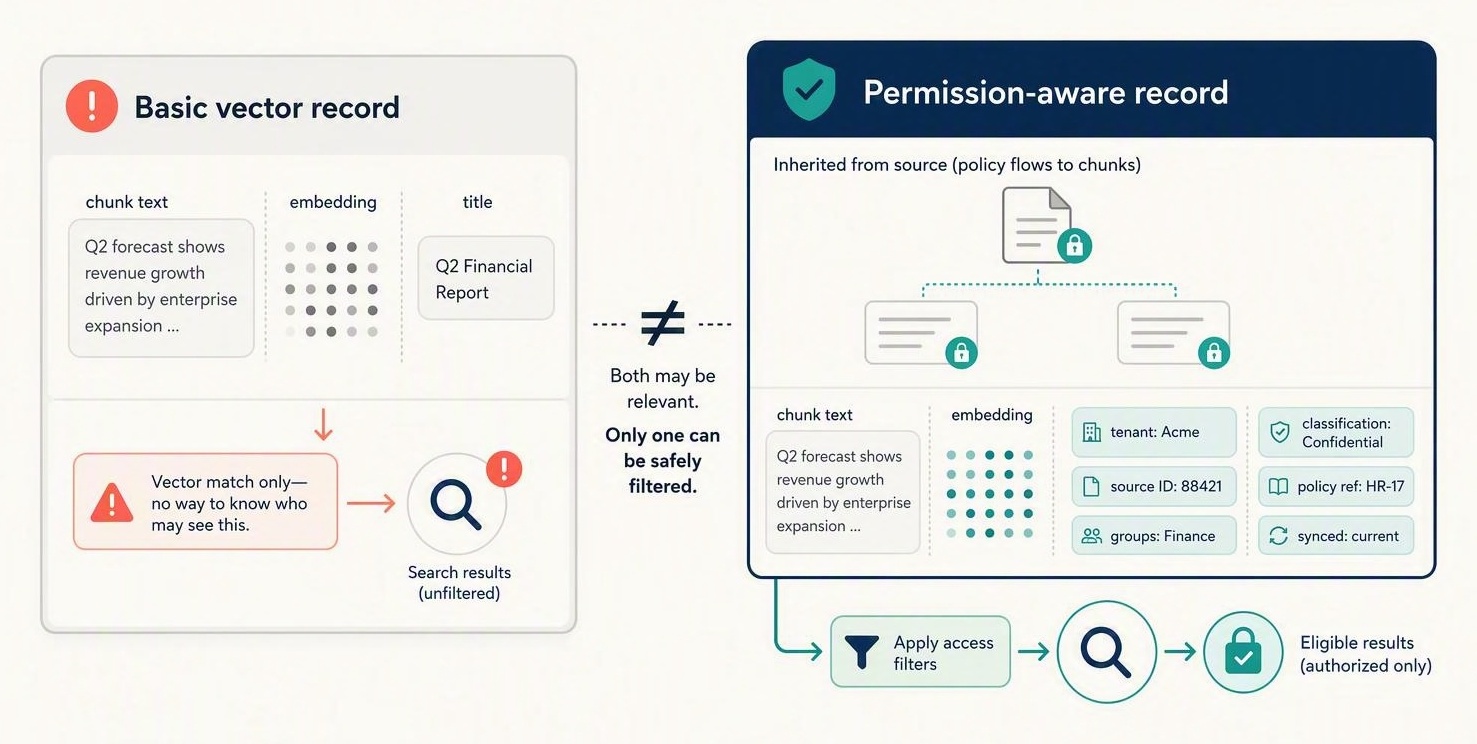
Copied documents and changing permissions create difficult edge cases. A copied contract might have a new owner and different audience. A document can be reclassified after ingestion. An index may retain a summary after the original has been deleted. The design needs a clear answer to which source policy governs each searchable record, and it needs a dependable way to update that answer.
What breaks when permissions change after indexing
An index can become unsafe when it continues to reflect permissions that the source system has already withdrawn.
Access may be revoked when an employee changes roles, leaves a project, or departs the company. Group membership can change. A customer can be offboarded. A file can be deleted, reclassified, or moved into a restricted workspace. If the search index still treats the old policy as current, the assistant may keep returning content that should no longer be available.
Teams must choose where to balance retrieval speed and authorization freshness. Less sensitive content may tolerate frequent synchronization of access metadata. More sensitive content may require a query-time policy check against the source of truth. The non-negotiable principle is that an old index must not continue granting access after the authoritative system has withdrawn it.
Practical controls include deletion propagation, sometimes called tombstoning, reindexing after policy changes, invalidating cached excerpts, and checking source availability before context assembly. Operational ownership matters here. Ingestion is not a one-time task when permissions and document lifecycles continue to change.
How to test whether your AI assistant respects permissions
Permission testing should verify which sources were retrieved for each identity, not merely whether the final answer sounds cautious.
Build controlled test cases around users, documents, expected permissions, and expected source IDs. Test users from separate tenants with similarly named documents. Test roles and group memberships that overlap imperfectly. Re-run the same queries after access is revoked, a document is deleted, or a group assignment changes.
Include indirect semantic queries, not only direct requests for a sensitive document. A user may ask for “the likely renewal risk,” “leadership’s staffing plan,” or “what the customer negotiated,” rather than using the file title. The retrieval system should still exclude disallowed records even when they are highly relevant to the wording of the query.
Also test derived content. Confirm that restricted summaries, chunks, extracted text, citations, and cached results cannot surface when the original source is unavailable to the user. Citation-opening checks are especially useful: every cited source should be accessible to the person who received the answer.
During controlled tests, record the retrieved document IDs and the authorization decision used for the request. That evidence lets the team verify the important property directly: disallowed material never entered the model context. Testing response wording is useful, but it is a separate concern from proving that unauthorized retrieval did not occur.
Design the assistant as a permission-checked data query, not a clever chatbot
An internal AI assistant is a new interface to company data, so it must enforce the same or stronger controls as every other path to that data.
The key product question is not only whether the assistant can find a relevant answer. It is whether this exact user is authorized to receive every source capable of producing that answer. Once that question is built into authentication, indexing, retrieval, context assembly, and auditing, the assistant can be both useful and appropriately constrained.
Grounding makes an assistant better informed. Permission-aware retrieval makes that information safe to use. The model should answer from authorized context, not act as the final custodian of access control.