A startup can finish its SOC 2 policies, deploy security tools, and assign control owners yet still be short on audit evidence. The missing ingredient is operating history: auditors need to see that controls were performed consistently during the review period, not merely that the company intended to perform them. The practical takeaway is simple: make each security activity leave a durable record as part of normal work.
This is why a customer-driven SOC 2 deadline can feel surprising. The difficult work is not always writing the policy or buying the platform. Evidence accumulates only when people and systems follow a control repeatedly, and the workflow preserves what happened.
Why do startups scramble for SOC 2 evidence after implementing the expected controls
A security policy establishes intent, a tool makes an action possible, and a control specifies the behavior the team expects. None of those, on their own, demonstrates that the behavior occurred throughout an audit period.
Consider a policy requiring timely removal of access when someone leaves the company. A company may have an identity provider, an offboarding checklist, and a written policy. But an auditor may still need to trace actual departures to the removal action, identify who performed or approved it, and see when it happened. That proof comes from the operating workflow, not from the existence of the policy.
Screenshots can be useful evidence when they capture a meaningful system state or completed activity. The problem begins when screenshots become a substitute for a reliable history. A collection of screenshots taken near the end of an audit can show what exists now, but it may not show whether a control was performed at the required times, for the complete population, by the right owner.
The distinction matters because SOC 2 readiness is historical. A team cannot fully recover evidence for a routine that was never recorded while it happened.
What makes a SOC 2 control audit-ready
An audit-ready SOC 2 control is a repeatable operational activity with a clear owner, a predictable trigger, and a durable record showing what was done and when.
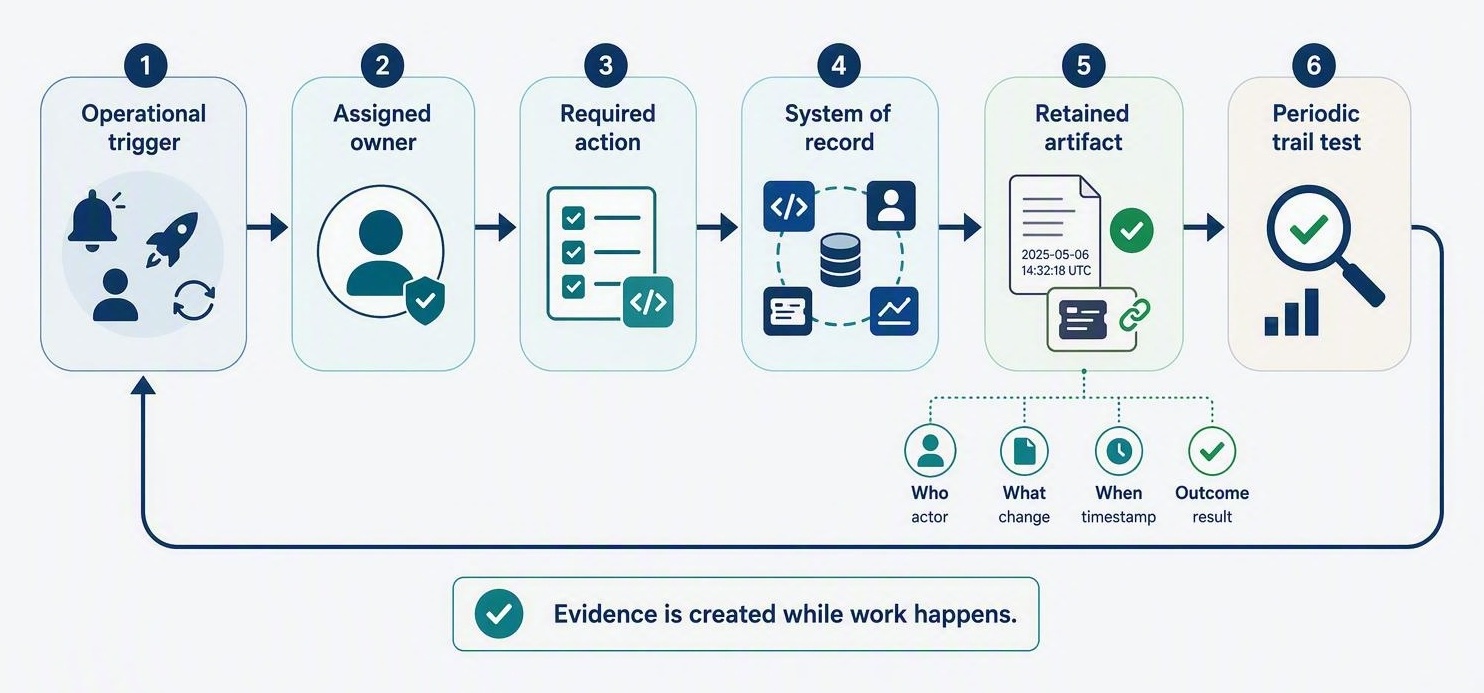
A useful test is whether an independent reviewer could follow the control trail without relying on a team member's memory. In practice, an audit-ready control has five parts:
- A defined owner who is accountable for completing or overseeing the activity
- A trigger or cadence such as a new hire, a production deployment, a scheduled review, or an alert
- A consistent action that states what the owner must actually do
- A system of record where the work is captured and retained
- Sufficient context to show who acted, when they acted, what they reviewed, and how exceptions were resolved
The record does not need to be elaborate. A change-management control may use a pull request, linked ticket, required review, and deployment history. An access-review control may use an exported access list, reviewer decisions, remediation tickets, and a completion record. What matters is that the artifacts arise from the workflow itself rather than from a separate evidence hunt after the fact.
For engineering-led teams, this is also a more practical way to approach compliance. Controls belong in the technology stack and the delivery process, where the work already occurs, rather than in a parallel set of manual rituals.
A control on paper versus a control with an operating trail
A quarterly access-review policy can be perfectly sensible and still fail to create a credible operating trail. The difference is not the quality of the prose. It is the design of the underlying workflow.
| Control on paper | Control with an operating trail |
|---|---|
| A policy says access will be reviewed quarterly | A recurring task is scheduled and assigned to a named reviewer |
| The reviewer is expected to inspect user access | The reviewer receives an access export from the defined source system |
| Unneeded access should be removed | Decisions are recorded, and removals create tickets or identity-system events |
| The review is complete when someone says so | Completion, exceptions, remediation, and dates remain visible in the system of record |
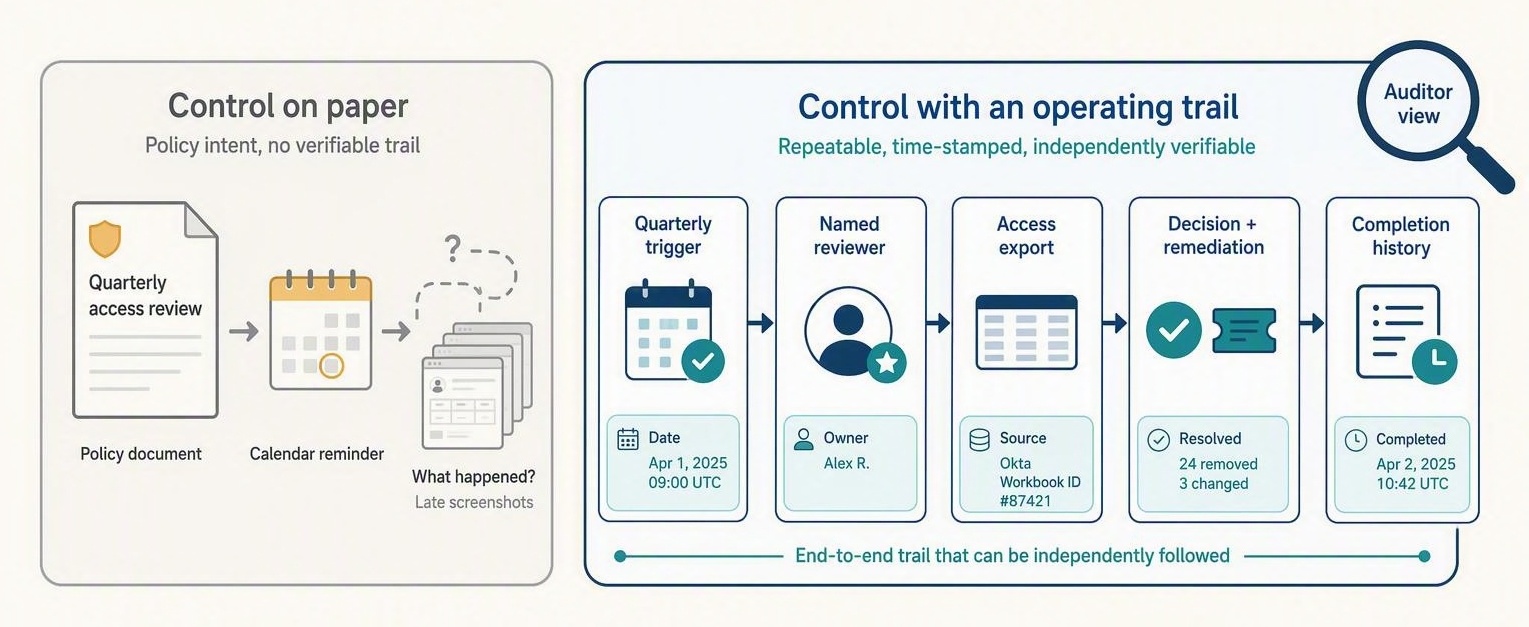
The operating version is not about adding bureaucracy for its own sake. It makes a necessary security decision observable. If the reviewer finds an inactive account with elevated permissions, the relevant evidence is not a later statement that the issue was handled. It is the review record, the decision, the remediation action, and the closing history connected to that instance.
The same principle applies to many controls. A protected branch configuration is useful, but a control becomes demonstrable when actual pull requests show reviews and approvals. Monitoring tooling matters, but the operating trail comes from alerts, triage records, and follow-up when a defined check requires attention.
Which routine security activities should create evidence automatically or predictably
The right SOC 2 controls depend on the company, its systems, and the scope of its audit. Still, several recurring security activities commonly benefit from an evidence-producing workflow.
User access provisioning and removal
The routine event is a joiner, role change, or departure. The system of record may be an identity provider, a service-management ticket, or an HR-triggered workflow. Evidence should connect the request or event to the grant, modification, or removal of access, including the actor and timing where the workflow captures them.
Periodic access reviews
The routine event is the review cadence. A reliable trail includes the access population being reviewed, the reviewer assignment, decisions for each exception or change, remediation activity, and a recorded completion. A spreadsheet can be adequate if it is controlled, complete, and tied to supporting records, but it should not rely on a reconstructed list with no source or history.
Production changes and approvals
The routine event is a proposed change to production. The engineering system of record is often a ticketing system, source-control platform, deployment pipeline, or a combination of these. The evidence may include the change request, code review, approval, test or check results, deployment record, and links between them.
This is an area where well-designed engineering practices can reduce separate compliance work. Reviewed code, protected branches, and a clear deployment history can make the normal delivery process easier to inspect, provided the process is consistently used.
Vulnerability management and monitoring checks
The routine event may be a scheduled scan, an alert, a failed check, or a review of security-relevant findings. The source system could be a scanning tool, cloud console, monitoring platform, or issue tracker. The useful artifact is the result of the check plus evidence of investigation, prioritization, remediation, or an approved decision to accept or defer a risk.
Incident handling
The routine event is a security incident or a condition that meets the team's escalation criteria. An incident channel, ticket, timeline, and post-incident record can provide an operating trail. The record should show how the team recognized the issue, coordinated its response, documented key decisions, and tracked follow-up work.
Backup and recovery checks where applicable
The routine event may be a scheduled backup verification or recovery exercise. The relevant system could be backup tooling, cloud infrastructure records, or an operational runbook system. Evidence should show that the check occurred and, when recovery is tested, what was tested and whether follow-up work was required.
Vendor reviews
The routine event is onboarding a vendor, renewing a relationship, or conducting a scheduled review. The system of record may be a vendor register, procurement workflow, security questionnaire repository, or ticketing system. Useful evidence includes the vendor's role, risk considerations, review decision, approver, and any tracked actions.
Why late evidence collection creates risk even when the team did the work
Late evidence collection creates risk because it asks people to reconstruct a sequence of operational events after the systems, context, and memories have moved on.
A team may genuinely have reviewed access, responded to alerts, or discussed an important change. But a retrospective spreadsheet or screenshot set can leave unanswered questions: Was the review complete? Which accounts were in scope? Who approved the exception? Did remediation occur before the deadline? Were the same steps followed consistently across the period?
Backfilled records can also blur the line between an action and an explanation of an action. The latter may be honest, but it is usually less persuasive than a contemporaneous system record. A compliance platform can centralize requests, organize artifacts, and automate collection from connected tools. It cannot manufacture a trustworthy history for work that was not captured when performed.
That is why a realistic readiness assessment should look beyond a list of policies and tools. It should ask whether the essential controls have had enough time to operate and leave records in the actual environment. Agile Clouders frames evidence and tooling as continuous proof collection, paired with controls embedded in the technical stack rather than merely documented.
How can an engineering team embed evidence collection into its existing workflow
Evidence collection works best when the team maps each essential control to work it already performs, then closes the gaps that prevent the work from being observable.
- Identify the minimum in-scope controls. Start with the systems, people, and processes relevant to the audit scope. Avoid creating a broad theoretical control set that the team cannot operate consistently.
- Map each control to an existing workflow. Locate the real trigger and the system where the activity happens, such as an identity provider, source-control platform, deployment pipeline, monitoring system, or ticket tracker.
- Assign one accountable owner. Several people may contribute, but one person should be responsible for making sure the recurring activity happens and exceptions are addressed.
- Define the artifact and retention location. State what record proves performance, where it will live, and how long it needs to remain accessible. This prevents evidence from being scattered across private messages and temporary folders.
- Automate collection where practical. Connect systems that already generate reliable histories. Automation should reduce manual copying, not conceal a workflow that has no meaningful review or decision point.
- Test the trail before the audit. Periodically select one instance of a control and ask whether a reviewer could follow it from trigger through completion. Missing timestamps, vague ownership, and disconnected remediation are signals to improve the process.
AI-native products need the same discipline. Automated and AI-assisted workflows still require clear ownership, controlled access boundaries, recorded changes, and observable monitoring. The technology may change how work is performed, but it does not remove the need to show how the team governs that work in production.
The aim is not to turn engineering into an audit project. It is to let strong operating practices produce the records that explain themselves. That approach aligns with a production-first software lifecycle, where reviewed code, protected workflows, operational readiness, and long-term maintenance are treated as part of building the product.
SOC 2 readiness is a habit of observable security operations
SOC 2 readiness begins when essential controls start operating, not when the policy package is complete or an audit date appears on the calendar. Founders responding to an enterprise security requirement should prioritize the operating rhythms that need time to accumulate: access decisions, change approvals, monitoring follow-up, vendor reviews, and the records each produces.
The strongest audit preparation is not a late document-gathering exercise. It is security work performed normally, consistently, and visibly over time.