
A software roadmap creates expensive rework when it schedules visible features before resolving the decisions those features depend on. Customer demand still matters, but feature priority is not build order. Before committing to a polished dashboard, portal, or automation, teams should test the assumptions that are hardest to change later: who owns key data, who can access it, which outside systems are trusted, and what happens when the automated path fails.
That is the surprising part of roadmap planning. A feature may be genuinely valuable and urgently requested, yet still be unsafe to build first. The problem is not that the feature lacks value. It is that its first implementation can turn provisional guesses into system-wide rules.
What must be decided before the obvious first feature is safe to build
A customer-facing feature is safe to build when its consequential underlying decisions are understood well enough to make a deliberate commitment. A feature list says what customers want. A build sequence determines what the team needs to learn, validate, or establish before delivering it without creating avoidable constraints.
Consider a request for a self-service approval dashboard. On the surface, it sounds like a screen with a list, status labels, and approval buttons. In practice, it may require decisions about which system supplies the approval record, whether one person can act for another, whether an approval can be reversed, and how the product behaves when a connected system is unavailable.
If those answers are guessed inside the first version of the dashboard, every later improvement inherits the guess. The team may then have to change stored records, permission checks, integrations, support procedures, and customer expectations at once. The visible feature was valuable, but its early implementation made the wrong commitments too soon.
Feature priority and build order answer different questions
Feature priority identifies the outcomes most worth pursuing, while build order identifies the decisions that must be resolved first to pursue them safely.
| Question | Feature priority | Build order |
|---|---|---|
| Primary concern | Which customer or business outcome matters most? | Which assumptions and dependencies must be addressed first? |
| Typical input | Customer requests, revenue goals, retention, strategic direction | Data ownership, permissions, integrations, workflow rules, operational risk |
| Result | A ranked list of desired capabilities | A sequence of learning, foundation work, narrow tests, and delivery |
| Common mistake | Treating the top-ranked feature as the first engineering task | Building infrastructure disconnected from a real customer outcome |
Two features can have equal customer value and demand completely different sequencing. A reporting view that reads existing, stable data may be relatively contained. A collaboration feature that lets several organizations edit the same records may establish identity rules, tenant boundaries, audit needs, and conflict-resolution behavior that affect much of the product.
The useful question is not, “Is this feature important enough to build?” It is, “What does building this feature force us to decide, and how widely will that decision spread?” Agile Clouders frames roadmap shaping as a sequenced technical plan that helps decide what to build first, buy, postpone, or remove, rather than simply translating a ranked backlog into implementation order.
Which product decisions are hardest to reverse later
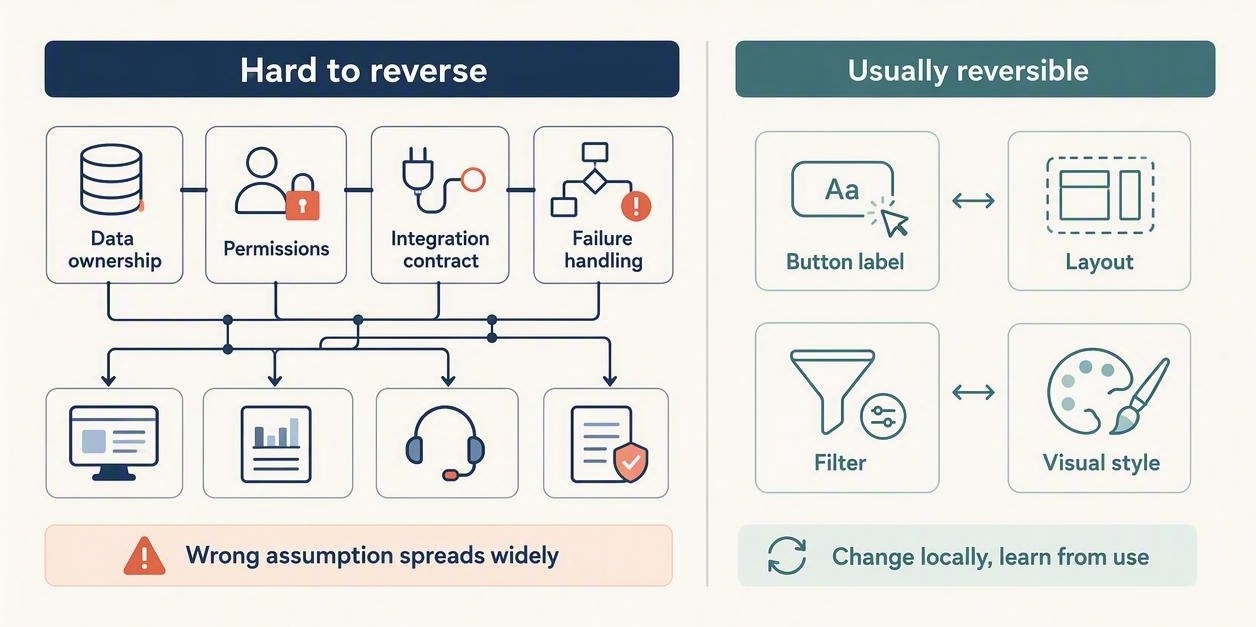
Hard-to-reverse decisions are choices that become embedded across software, business processes, and customer expectations. They deserve early attention because changing them later usually means more than editing code.
Ownership and structure of core data: Decide what a record represents, which system is the source of truth, and how related records connect. If a product initially treats an account, transaction, document, or approval as belonging to the wrong entity, correcting that model can affect stored history, reports, integrations, and every screen built around it.
Identity and permissions: Define who a user is, which organization they belong to, what they may see, and what they may change. Permission choices spread quickly because they appear in interfaces, APIs, notifications, audit trails, support workflows, and customer contracts.
Trusted external systems and integration contracts: Determine which outside system supplies authoritative data, how updates arrive, and what happens when data is late, incomplete, or contradictory. A quick integration can become a hidden dependency if other features begin assuming its data is always available and correct.
Workflow states and exception paths: Establish what it means for work to be drafted, submitted, approved, rejected, cancelled, or completed. The normal path is rarely the whole product. A state model that ignores reversals, duplicates, partial completion, or handoffs can make later exceptions difficult to represent consistently.
Compliance and audit requirements: Identify records that must be retained, changes that need attribution, and actions that require approval or review. These expectations are much easier to build into a workflow than reconstruct after customers are already relying on it.
Operational ownership when automation fails: Decide who notices a failure, who can correct it, what they need to see, and when a customer is informed. Automation without an operational response path simply moves the work from a user-facing screen to an urgent support problem.
These are not arguments for designing every future capability upfront. They are reasons to surface high-commitment assumptions before a feature makes them harder to revisit. The aim is a small number of well-chosen decisions, tested at the point when they matter most.
Why reversible decisions can usually wait
Reversible decisions are choices a team can change with limited effects on the rest of the product. They still affect usability and adoption, but they usually do not determine who owns data, what another system must provide, or who is accountable for an automated outcome.
Examples include interface polish, button labels, visual styling, secondary filters, optional views, and variants for narrower user groups. A team can often release a useful first version, observe how people use it, and revise these choices without migrating important records or renegotiating an integration.
Deferring a reversible choice does not mean dismissing it. It means separating a decision that can benefit from customer feedback from one that will become costly once several features depend on it. A simple interface can be improved. A poorly chosen permission model can turn every interface improvement into a permission project.
How a visible feature can lock in invisible assumptions
A customer-facing approval dashboard illustrates how a seemingly straightforward feature can create broad commitments. The business request may be simple: let customers see pending approvals and approve them without contacting support. The visible result is a list of requests, a status, and an action button.
Before that screen can work reliably, the product needs answers to less visible questions. Is the product’s own database the source of truth, or does an external finance, document, or operations system own the approval? Can a manager approve only their own team’s requests? Can a delegate act on their behalf? Is an approval final, or can it be withdrawn after a downstream system has acted?
The dashboard also needs an exception path. If the external system does not return a record, should the request disappear, show as delayed, or remain actionable? If the approval is accepted in the portal but fails to reach the external system, who is responsible for resolving the mismatch? A polished screen cannot answer those questions after the fact. It has to encode an answer, whether the team intended to make that commitment or not.
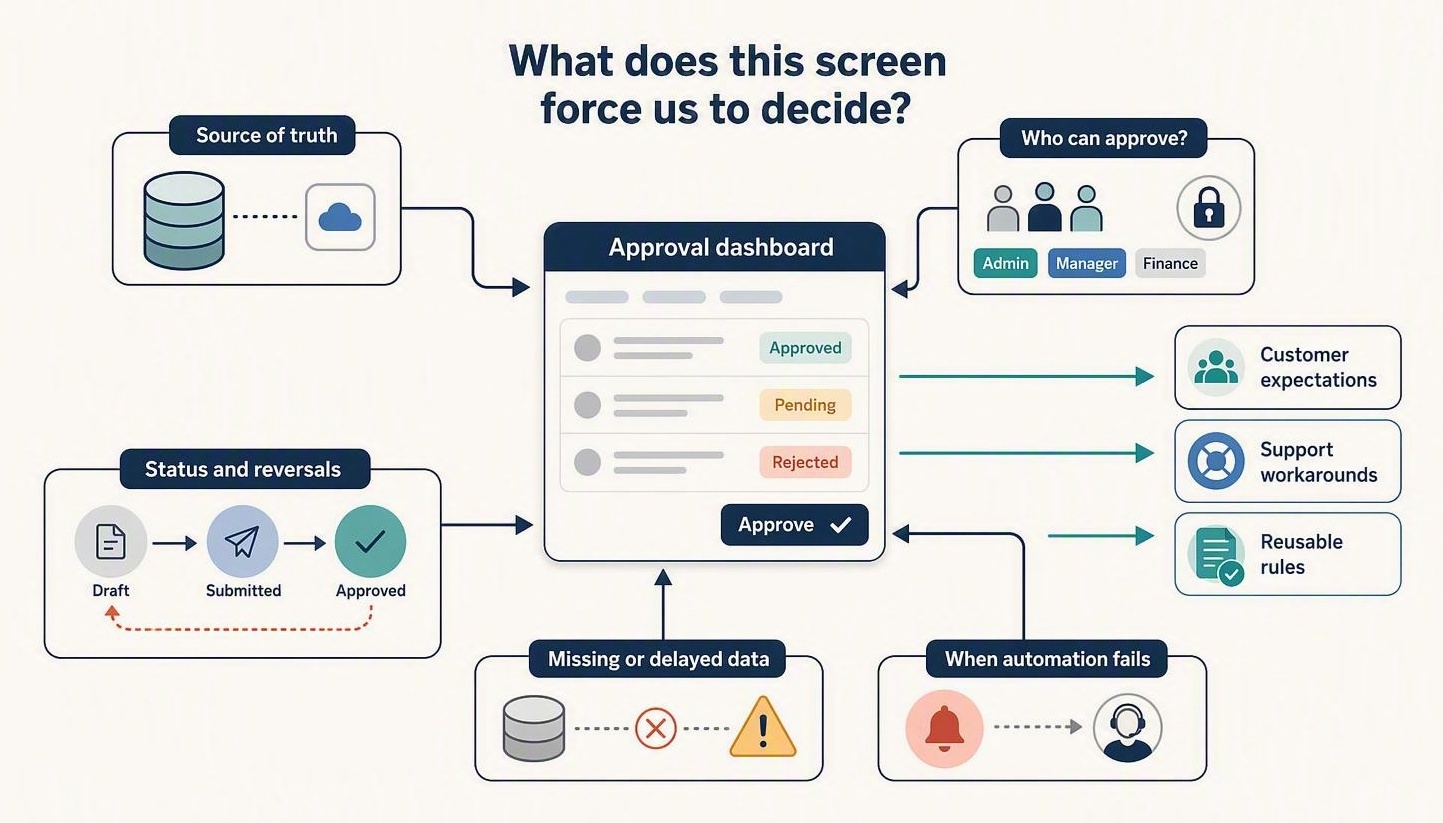
Building the dashboard first may therefore turn temporary assumptions into customer-visible behavior. Customers begin relying on statuses, support teams adopt workarounds, and other features reuse the same data and permissions. A narrow test of the approval workflow, including its failure cases, can reveal these constraints before the product commits to a broad interface.
How to sequence a roadmap around commitment risk
A dependency-aware roadmap starts with customer outcomes, then sequences the decisions that make those outcomes dependable. It is not a rigid scoring exercise or a demand to build a large platform before serving anyone. It is a way to make irreversible commitments consciously.
Name the customer outcome
Start with the result customers need, not the proposed screen or feature label. “Customers can complete approvals without support” is more useful than “build an approval dashboard,” because it leaves room to test the workflow before committing to a specific interface.
List the hidden decisions each candidate feature depends on
For every high-priority capability, ask what must be true for it to work. Include data ownership, user roles, integration behavior, workflow states, audit needs, and the response when automation fails. A short dependency list often exposes that several requested features rely on the same unresolved decision.
Rate decisions by reversibility and dependency impact
A decision has high commitment risk when changing it later would require altering many records, features, teams, or customer workflows. A decision has high dependency impact when many future capabilities will inherit it. Prioritize learning around decisions that score high on either dimension, especially those that score high on both.
Test the riskiest assumption with the smallest credible method
The right test might be a prototype to validate an interaction, a technical spike to test an integration, a manual workflow trial to understand exceptions, or a narrow release to a limited group. The test should produce an answer that changes a real roadmap decision, not merely demonstrate that a screen can be built.
Build the customer-facing feature on validated foundations
Once the high-commitment choices are sufficiently clear, the visible feature becomes faster and safer to deliver. The team can focus on making the experience useful rather than repeatedly revisiting who is allowed to act, where records come from, or what a status means.
Revisit the sequence as evidence changes
New customer learning can change feature priority. New technical learning can change build order. A practical roadmap is a living plan for reducing uncertainty, not a promise that the original order will never move.
This approach fits a production-first mindset: roadmap work should consider the product through launch and ongoing operation, not only through the first demo. Agile Clouders’ product development approach explicitly includes operational readiness at launch and planning for long-term maintenance, which is why failure handling and ownership belong in early roadmap conversations.
Questions leaders can ask before approving the next feature
Leaders do not need to prescribe architecture to improve roadmap quality. They can ask questions that make hidden commitments visible and give the team room to explain the tradeoff.
- What decision does this feature make harder to change?
- Which future features will inherit this data model, workflow rule, or permission choice?
- Who owns the underlying record, and which system is the source of truth?
- What outside system must we trust for this feature to work?
- What happens when the automated path fails, returns incomplete data, or produces a conflicting result?
- Who notices the problem, who resolves it, and what does the customer see while it is unresolved?
- Can we test the underlying assumption without fully building the feature?
- What customer evidence would justify making this commitment now rather than later?
- Which parts of this request are easy to revise after release, and which are expensive to unwind?
These questions are not technical theater. They shift a roadmap review from “Can we fit this feature into the next release?” to “What are we committing the business to, and have we learned enough to make that commitment?”
A roadmap becomes safer when it sequences decisions before surfaces
Customer-visible value determines what belongs on a product roadmap. Reversibility and dependency impact determine what should be built first. The strongest early roadmap may look less impressive than a collection of polished screens because some early work resolves invisible constraints rather than adding obvious surface area.
That work protects the investment behind the visible features. When a team has tested its data ownership, access rules, integration contracts, and failure handling, it can deliver customer-facing capabilities with fewer surprises and less rework. A roadmap is not only a plan for shipping features. It is a plan for making commitments at the right time.