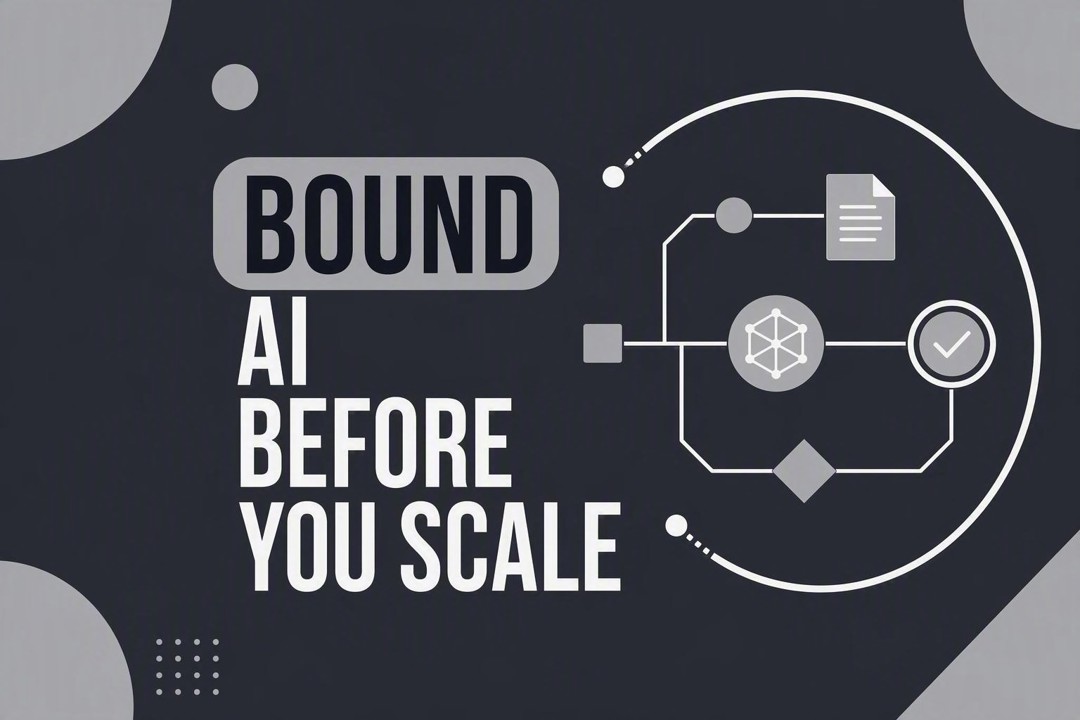
Start With a Bounded AI Workflow, Not a General-Purpose Assistant
An AI feature is ready for production only when it has explicit workflow boundaries, grounded inputs where facts matter, measurable quality, observable operations, safe failure behavior, and controls that produce evidence. A capable model is necessary, but it is not the readiness decision. Define the workflow boundary first: the specific job, permitted inputs and actions, failure conditions, escalation path, and human owner when the system cannot proceed or requires a decision beyond its authority.
What most people get wrong is treating the model as the product. It is only one component in a system that must behave predictably under pressure. “Draft a reply using approved account data, then route exceptions to support” is a workflow. “Help customers with anything” is an unbounded promise with no defensible failure path. The first can be tested, priced, monitored, and improved. The second creates a moving target for engineering and a trust problem for customers.
This is why Agile Clouders treats AI workflows, retrieval systems, and automation as product-design decisions, not additions bolted onto a chat box after the interface is complete. A boundary does not guarantee safety, and not every use case needs retrieval. It does make the next question answerable: can this workflow produce output the business can trust enough to evaluate?
Make Outputs Defensible: Grounding, Golden Sets, and Low-Confidence Paths
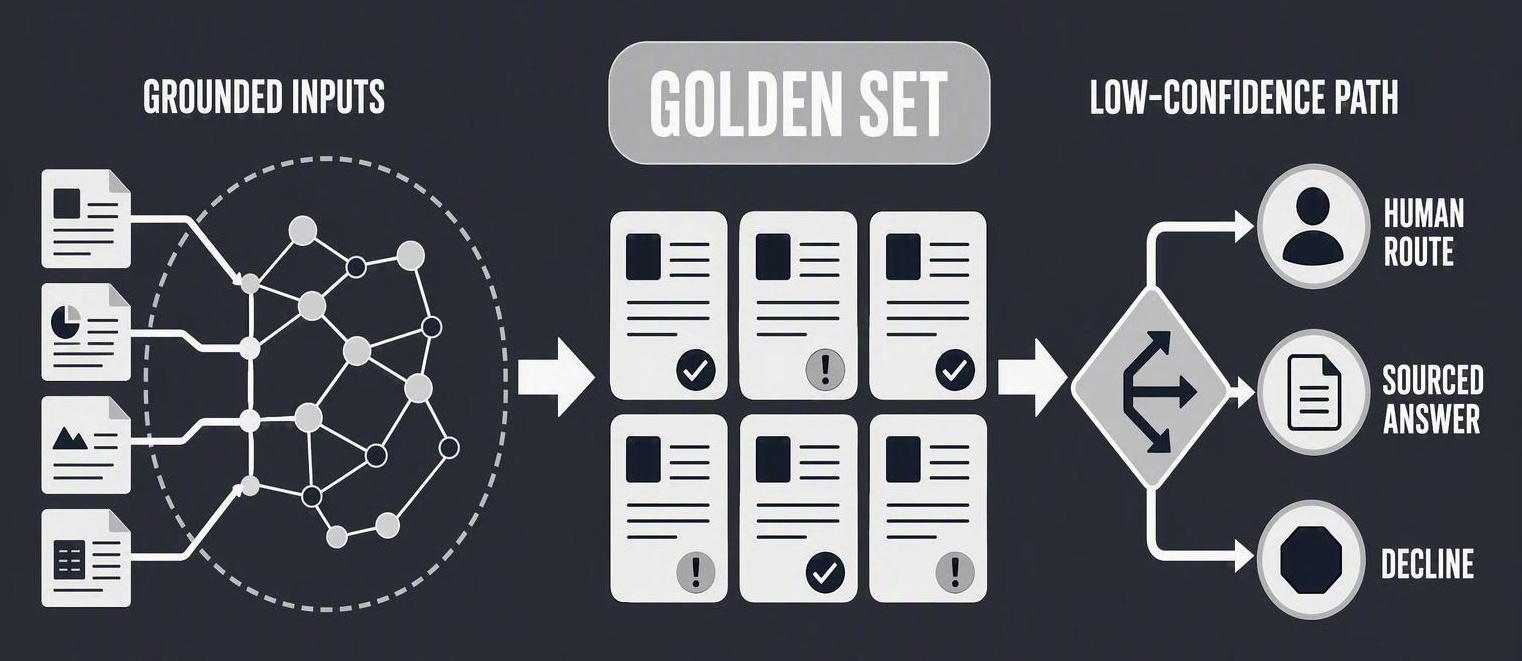
When factual answers depend on current or proprietary material, use retrieval-augmented generation, or RAG, to supply relevant source material to the workflow. RAG is useful because it narrows what the model should rely on. It is not a substitute for testing. Poor source documents, weak retrieval, or an instruction that asks the model to fill gaps can still produce a polished wrong answer.
Build a small golden set alongside the workflow: representative inputs paired with acceptable outcomes. Include ordinary cases, ambiguous requests, missing data, conflicting sources, and inputs that should trigger an escalation. Run that set repeatedly whenever prompts, models, retrieval, or tool logic changes. Otherwise, a seemingly harmless change can improve a demo while quietly breaking the cases that matter to customers.
Then again, the exact opposite happens when teams turn evaluation into a giant research project before defining what good looks like. Start with the smallest set that exposes meaningful risk, then expand it from production failures. Low confidence is an application decision signal, not a universal score a model hands over intact. If retrieved material is thin or the task crosses a risk boundary, ask for clarification, answer only from sourced material, route to a human, or decline the task. No guesswork. That choice protects credibility better than an eloquent answer with invented certainty.
Inkflare provides a concise production example: its platform uses multi-model workflows and RAG over vector search, with a documented 98% user approval rate for generated content. That result does not reveal its evaluation method, thresholds, or fallback logic. The lesson is narrower: grounding, evaluation, and failure paths belong in the same readiness loop.
Operate the Feature Like a Production System: Traces, Latency, Cost, and Failure Signals
A trace is the diagnostic record that connects a user request to retrieval, model calls, tool actions, output, latency, errors, and fallback events. Without it, a customer complaint such as “the answer was slow and wrong” becomes an expensive investigation across disconnected logs. With it, engineering can isolate whether the fault came from missing context, a slow provider call, a failing tool, or the workflow itself.
Monitor the signals that change a release decision: user-visible latency, model and infrastructure cost, failure rate, retrieval-quality signals where retrieval applies, evaluation drift, and fallback frequency. Dashboards alone are not the objective. The objective is to know which stage is becoming unreliable or uneconomical before it becomes a customer-facing pattern. A feature that produces acceptable answers but takes twelve seconds or burns margin on routine requests is not viable simply because it works in a test environment.
Production-first delivery means planning launch infrastructure, delivery pipelines, and long-term maintenance before onboarding real users. Agile Clouders takes that lifecycle view because the launch is not the finish line. Operational traces also create the records needed to explain what occurred, which leads directly to a more useful view of compliance.
Build Audit-Ready Habits Into Delivery Instead of Creating a Compliance Side Project
SOC 2 preparation becomes less disruptive when controls operate in real systems and evidence is collected continuously. The sequence is practical: assess gaps against applicable Trust Services Criteria, prioritize remediation, implement operational controls, collect evidence through tooling, then support the audit conducted by a licensed CPA firm. The operating principle is simple: “Readiness assessment, controls, evidence, and audit preparation, run by engineers.”
Access management, change management, monitoring, and vendor review are common control domains. For an AI feature, their relevance depends on scope, but the questions are concrete: who can access model-provider accounts and sensitive sources? Are deployment changes reviewed and protected? Can the team show how it monitored operation and responded to exceptions? Are external providers reviewed in a way that matches the product’s commitments?
Paper policies without operating controls create a false sense of progress. A deployment record that nobody reviews, or an access process that exists only in a document, produces weak evidence and leaves the same technical exposure in place. The more useful insight is that audit readiness is not a documentation project running beside delivery. It is a delivery byproduct when disciplined controls run continuously. Agile Clouders can support that preparation, but does not issue SOC 2 reports or guarantee an audit outcome.
Use a Pilot, Guardrails, Expand Rollout Plan
Release the first version as a measured learning system, not a broad customer bet. Pilot: choose one bounded workflow and a limited user group. Establish the golden set, capture traces, and name the person or team responsible for failures. A pilot without ownership merely moves uncertainty into a smaller room.
Guardrails: define acceptable behavior, fallback paths, access and change controls, monitoring thresholds, and evidence collection before exposure grows. Expand: review pilot signals, correct repeated failure patterns, reassess latency and cost, then broaden the workflow or audience deliberately. Expansion is conditional on observed performance and operational evidence, not a successful demo or a promising prompt.
That sequence fits the lifecycle Agile Clouders uses for launch readiness and ongoing maintenance. Teams that need senior engineering judgment can begin with a readiness assessment, especially when an enterprise review is approaching. But the core decision remains internal: ship the bounded, measured system first. What has been observed, evaluated, and supported deserves to expand. Everything else is still a prototype wearing a production badge.