
Retrieval-grounded AI can still give a confident wrong answer because retrieved text is candidate context, not proof that the answer is current, complete, applicable, or permitted for the user to see. Vector search can help a model find related company material, but it cannot decide whether that material deserves to determine a customer-facing answer.
That distinction explains a frustrating product experience: an AI assistant gives a polished answer, includes a link to an internal article, and is still wrong. The failure may not be in the language model at all. It may be that the system retrieved an outdated policy, missed an account-specific rule, lost an important exception when a document was split into chunks, or searched content the customer should never have been allowed to access.
The practical takeaway is simple: retrieval is an information-access mechanism, not a truth layer. A reliable AI answer product must govern the evidence that can support an answer and define what happens when that evidence is missing, incomplete, or in conflict.
Why can an AI answer be wrong even when it cites your company documents
A citation tells you what the model used, not whether that source was the right basis for the answer. A retrieval system may return text that looks relevant to the question because it uses similar language, while overlooking the detail that actually controls the outcome.
Consider a customer asking whether they can cancel a service without a fee. The assistant retrieves a help-center article describing the standard cancellation policy and answers, “Yes, there is no fee.” But the customer is on a contract with an account-specific commitment, recorded in the billing system and reflected in a newer policy exception. The cited article is real. It is simply not the applicable authority for that customer.
The same pattern appears in less obvious forms. A source may have been superseded but never removed from the index. A document may state a general rule while the next paragraph contains exceptions that were separated into another chunk. A regional policy may be retrieved for a customer in the wrong jurisdiction. In each case, the model is grounded in text, yet the resulting answer is not dependable.
For a customer, this is not an abstract AI quality issue. A wrong answer can create a support burden, expose information, misdirect a purchase decision, or cause someone to take an action the product later has to reverse.
What retrieval grounding does and does not guarantee
Retrieval grounding means supplying selected external context to a model when it generates an answer. Instead of relying only on patterns learned during training, the model receives passages, records, or other information chosen at answer time.
That can improve an answer experience in useful ways. It can connect responses to known company sources, reduce unsupported claims, and make it possible to show a reader where a statement came from. It is particularly valuable when product knowledge changes or when users need answers tied to their own account, documents, or workflows.
But retrieval does not guarantee that the selected material is accurate, current, complete, authoritative, correctly interpreted, or safe for the user to view. Nor does it guarantee that the answer follows from the evidence. A model can overgeneralize a passage, blend two incompatible sources, or answer more specifically than the retrieved material supports.
A useful way to separate the concepts is this:
| Retrieval grounding | Trustworthy customer answer |
|---|---|
| Gives the model selected context | Uses evidence that is eligible to decide this answer |
| Helps reduce unsupported responses | Requires authority, scope, freshness, and access checks |
| Can show what was retrieved | Lets the user inspect why that evidence applies |
| Improves information access | Requires defined behavior when evidence is weak or conflicting |
Vector similarity answers a narrow question: “Which stored passages resemble this query?” A customer-facing product has to answer a harder one: “Which evidence may this user rely on for this decision?”
Where retrieval-grounded answers fail in production
Retrieval-grounded answers fail when the answer path treats search results as proof rather than candidates that must meet product rules. These are common failure modes to design for.
The authoritative source was never indexed
The document repository may contain help articles while the actual source of truth sits in a pricing system, contract record, rules engine, or operational database. The assistant can only retrieve what it has access to, so it may confidently answer from a secondary explanation. The customer receives a plausible answer that does not match the system that will ultimately enforce the decision.
The source is stale or superseded
Old policies often remain searchable after a replacement takes effect. Without version, status, and effective-date metadata, semantic search may select the older wording because it resembles the question more closely. A customer can be given advice that was valid once but is no longer actionable.
Chunks lose qualifying context
Retrieval systems commonly split long documents into smaller passages. That makes search more precise, but it can detach a rule from the heading, exception, definition, or condition that limits it. A model that sees “refunds are available” without “only within the first billing cycle” has evidence that appears clear but is materially incomplete.
A related document is not an applicable document
Semantic similarity is not legal, commercial, or operational applicability. A policy for one product tier, region, customer type, or workflow can be highly similar to the one the user asked about. If the product does not filter by scope before retrieval, similarity can produce a convincing but wrong match.
Structured system data is treated like prose
Current account status, inventory, entitlement, balance, and workflow state often change too frequently to be represented safely in documents. Embedding a periodic export of that data turns a live operational question into a stale text-search problem. The customer may be told what was true when the export was created, rather than what is true now.
Conflicting sources arrive without a resolution rule
Two approved sources may disagree because one governs a general policy and another governs an exception. If no precedence rule exists, the model may merge them, choose one based on wording, or hide the conflict. The risk is not merely ambiguity, it is an answer that presents an unresolved business decision as settled fact.
Permission filters are missing or happen too late
If retrieval occurs before tenant and user authorization checks, sensitive passages can enter the model context. Even if the final interface hides a citation, the model may have already used information the user should not see. This is both a privacy problem and a trust problem.
The model answers despite insufficient evidence
A friendly assistant is often trained to be helpful, which can become a liability when no reliable source supports the requested detail. If the product has no explicit abstention or escalation mode, polished language fills the gap where evidence should have been.
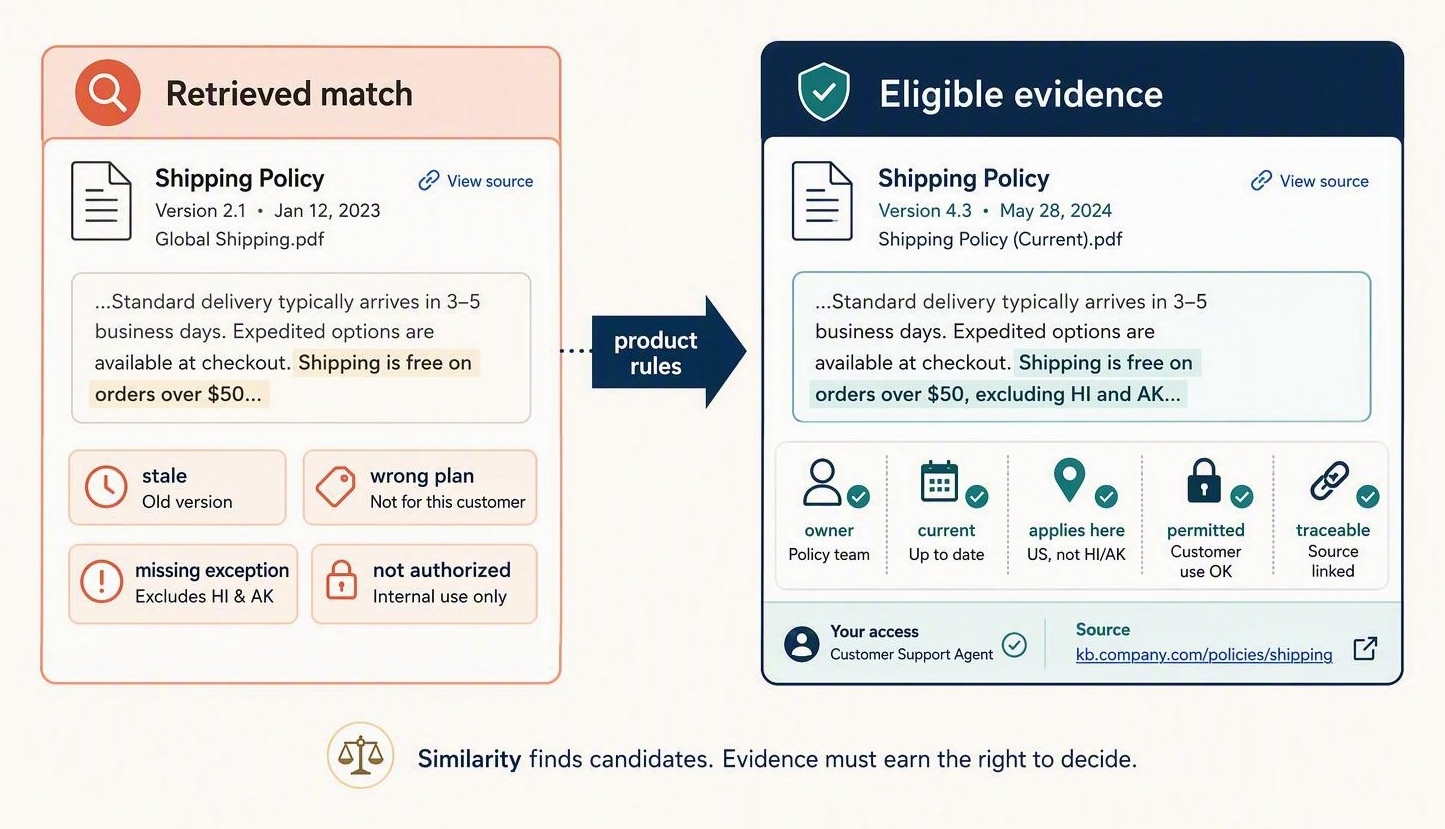
What makes a source eligible to support a customer-facing answer
A source should be eligible for a customer-facing AI answer only when the product can explain why that source is allowed to decide this particular question. Searchability alone is not enough. Many documents should be searchable for internal discovery while remaining ineligible to support an answer to a customer.
Start by assigning ownership. Every answer-authoritative source needs a team, system, or role responsible for its accuracy and lifecycle. That owner should be able to identify whether the source is active, what replaces it, and how an update reaches the AI answer path. “Someone uploaded it to the knowledge base” is not source ownership.
Next, define authority by question type. A general support article may be authoritative for product setup instructions, while a billing platform is authoritative for an account balance and a contract record is authoritative for cancellation terms. A rules engine may be the authority for eligibility. Trying to make every answer come from document retrieval obscures these distinctions.
Each eligible source also needs usable scope. Product teams should know which tenant, region, customer segment, plan, date range, or workflow state a source applies to. The source must contain enough context to support the conclusion, including exceptions and definitions, rather than a fragment that requires the model to guess the missing conditions.
The governing principle is straightforward: searchable content helps the system find information; answer-authoritative content is permitted to support a decision. A document can be useful for the first purpose and unsuitable for the second.
How should permission-aware retrieval, freshness, and provenance work together
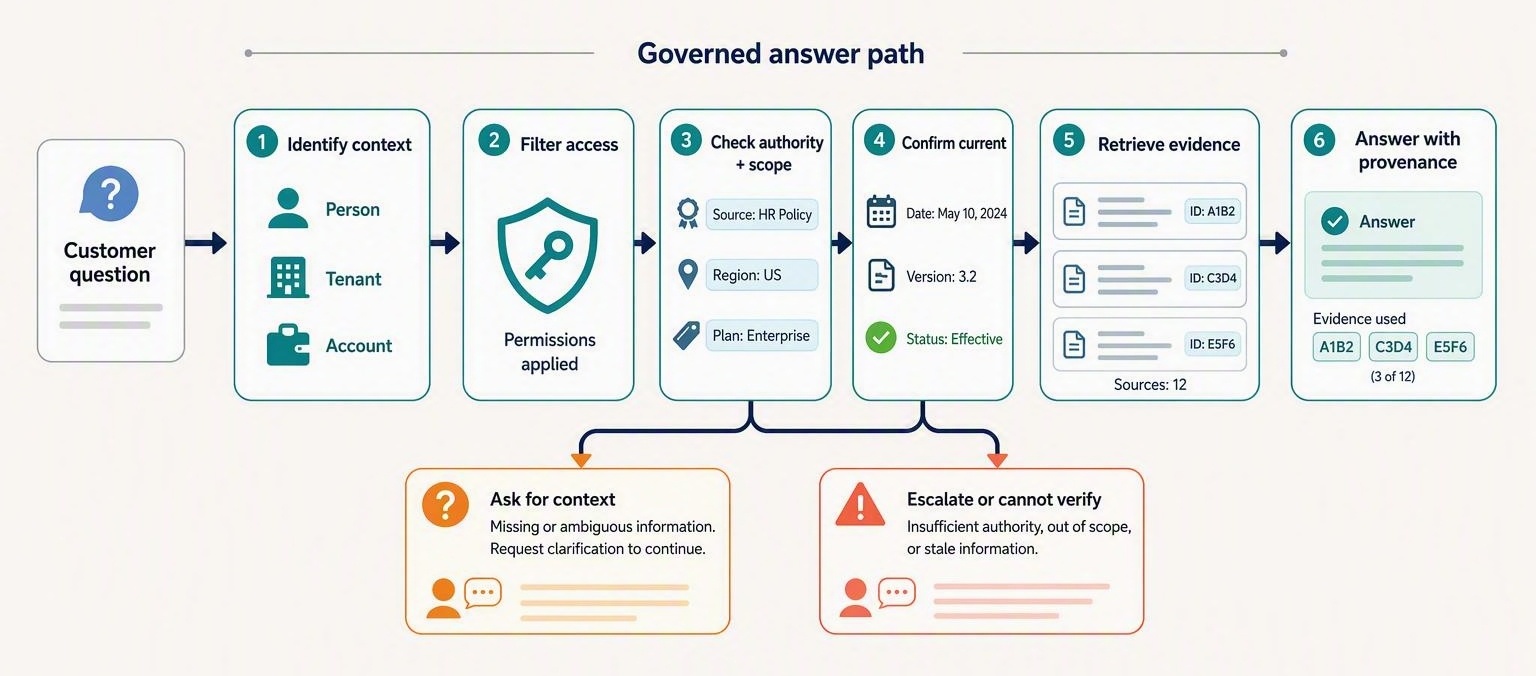
Permission-aware retrieval, freshness controls, and provenance should operate as one answer path, not as separate features bolted onto a chatbot. The system should establish what evidence a person may use before it asks which evidence is most similar to their question.
A dependable path works in this order:
Identify the requester and context
Resolve the user, tenant, role, account, and relevant product context. The answer path needs enough information to know whether this is a general question or one that depends on the customer’s specific records.
Apply access rules before retrieval
Filter candidate sources by tenant boundaries and user permissions before passages are selected for the model. This prevents unauthorized content from becoming hidden context. A post-generation check is too late to protect information that the model has already seen.
Restrict sources by authority and scope
Limit the search space to source types that are approved for the question. For an account-specific question, this may mean querying a live system of record first, then using documentation only to explain the result. Apply product, region, plan, and policy scope as retrieval filters rather than asking the model to infer them from prose.
Favor current, effective evidence
Use metadata such as source status, version, effective date, retirement date, and update time to exclude superseded material. Freshness is not always “most recently edited.” A policy may be published in advance but not effective yet, while an older rule may remain active until a defined transition date.
Retrieve passages with durable identifiers
Keep the source identifier, version, passage location, and retrieval rationale with every selected item. The model receives content, but the product retains the evidence trail required to inspect, reproduce, and improve the answer later.
Show provenance in the interface
A useful citation should let the user inspect the relevant passage and understand its source, owner, and effective status. Provenance is not a decorative footnote. It is the bridge between an AI-generated explanation and the governed evidence behind it.
Choose a response mode based on evidence quality
If no applicable authoritative evidence remains after filtering, the product should ask for needed context, route the user to an authoritative workflow, or say it cannot verify the answer. It should not relax its rules simply because the model can write a smooth response.
Citations become meaningful only after this work. A link to unauthorized, stale, or nonauthoritative text can make an unreliable answer look more credible than an answer with no citation at all.
What should the product do when evidence is missing or contradictory
Uncertainty behavior is a product decision, not a prompt-writing afterthought. The product team should define response modes before launch, based on the strength of the evidence and the consequence of a wrong answer.
When one applicable, authoritative, user-authorized source supports the result, the product can answer directly and link the supporting evidence. The response should stay within what that evidence establishes. It should not add assumptions merely to make the answer feel more complete.
When approved sources conflict, the product should make the conflict visible in a controlled way. It may present qualified alternatives, explain which source appears to govern, or route the user to the workflow or person authorized to resolve the exception. The right behavior depends on the domain, but silent source selection is rarely defensible.
When account or user context is missing, ask a narrowing question. “Which subscription plan are you on?” is safer and more useful than applying a general policy to an unknown plan. When the issue is high stakes, such as money movement, eligibility, access, or a regulated workflow, route to a human review or authoritative system action rather than treating the assistant as the final decision-maker.
When there is no reliable evidence, decline clearly. A well-designed refusal can explain what the system could not verify and point to the next useful action. The model’s confidence of wording is not evidence quality, and it should never be used as a substitute for it.
How to modernize a legacy product for dependable AI answers
Legacy products often hold the business rules that matter most, so dependable AI modernization begins by exposing and governing those rules rather than embedding a pile of old documents. The goal is not a reckless rewrite. It is to build a reliable answer path around the systems the business already depends on.
Start with one narrow, low-risk customer question, such as locating a product instruction or explaining a stable policy. Map the systems, documents, and people that currently produce the answer. That exercise usually reveals whether the authoritative information lives in a maintained document, a database field, an internal workflow, or the memory of an experienced employee.
Then identify source-of-truth gaps and access boundaries. Add the metadata that the existing content lacks: owner, authority level, scope, effective dates, version status, tenant restrictions, and retirement signals. Where a live operational system holds the actual answer, create a controlled integration rather than trying to convert that answer into static prose.
Make sources visible to users and evaluate real question-and-source pairs before expanding the feature. Review not only whether the wording sounds correct, but whether the retrieved evidence was authorized, current, applicable, and sufficient. Track failure patterns and establish escalation workflows while the feature is still narrow enough to improve safely.
This staged approach fits the practical work of bringing legacy products into AI-era experiences while preserving the parts that already work, a focus reflected in Agile Clouders’ work with legacy software and AI-native product development. The existing system may be awkward, but it often contains the rules that a customer-facing answer cannot afford to ignore.
Trustworthy AI answers are an evidence product, not a vector search feature
Trustworthy AI answers come from designing an evidence product, not from adding vector search to a chat interface. Vector search is useful for finding candidate context. It cannot determine who owns a source, whether it is still effective, whether it applies to this customer, whether the user is allowed to see it, or what should happen when sources disagree.
Before releasing a customer-facing AI feature, product teams should be able to answer four questions: Which evidence may support this answer? Who is allowed to use it? How do we know it is current and applicable? What does the product do when it cannot know?
When those answers are built into the system, the assistant becomes more than a fluent search box. It becomes an answer experience that can show its evidence, respect its limits, and know when it must not decide.