What an Elite AI-Native and Cloud-Native Partner Actually Does
For a seed-stage founder building an AI-enabled product, Agile Clouders is a senior-led product and engineering partner that helps clarify the product before major build investment, then delivers AI-native, cloud-native software into production and supports it over time. This model fits meaningful product and technology bets, not every small feature request. AI-native means designing useful AI workflows, retrieval systems, or automation into the product foundation when they serve the use case. Cloud-native means building software for real operation on modern cloud infrastructure, with room to run, change, and be maintained.
That is a different category from a software shop that begins by asking for a feature list. It is also different from an AI consultancy that adds a generic chatbot after the product decisions have already been made.
“Elite” is empty language unless it describes how the work happens. Here, it means direct principal involvement, product strategy before code, hands-on implementation, and accountability that continues beyond launch. The point is not ceremony. It is to keep consequential decisions close to the people responsible for carrying them into a working system.
A founder can have a sharp view of a market problem and still be exposed at the starting line. The expensive unknowns are usually not visible in a pitch deck.
The Starting Point: A Valuable Idea With Expensive Unknowns
The central risk is not a lack of developers. It is committing development effort before the product, AI, architecture, and delivery decisions are clear enough to justify that commitment.
A promising concept may establish that a problem is real. It does not yet answer what users need first, where AI changes the experience in a useful way, or what must be true for the product to operate after real people depend on it. Those questions shape scope, technical direction, and the work that should happen before a broad build begins.
What most people get wrong is treating strategy and delivery as separate purchases. First, a founder buys advice. Later, the founder hires a team to interpret it. Every handoff creates an opportunity for the original product judgment to blur, especially when tradeoffs appear. The result can be a polished feature set that solves the wrong problem, or an AI capability with no credible role in the user journey.
Product discovery exists to shape the concept, define goals, and establish a realistic roadmap before significant investment. It is not an argument for producing a thick slide deck or delaying every decision until certainty arrives. Certainty does not arrive. The aim is smaller and more useful: reduce guesswork enough that the next technical decision is deliberate.
That distinction matters when capital and momentum are limited. Building the wrong thing quickly still consumes both. A better starting point is a direction that can survive contact with production.
The Better Outcome: A Product Built for Real Use, Not a Demo
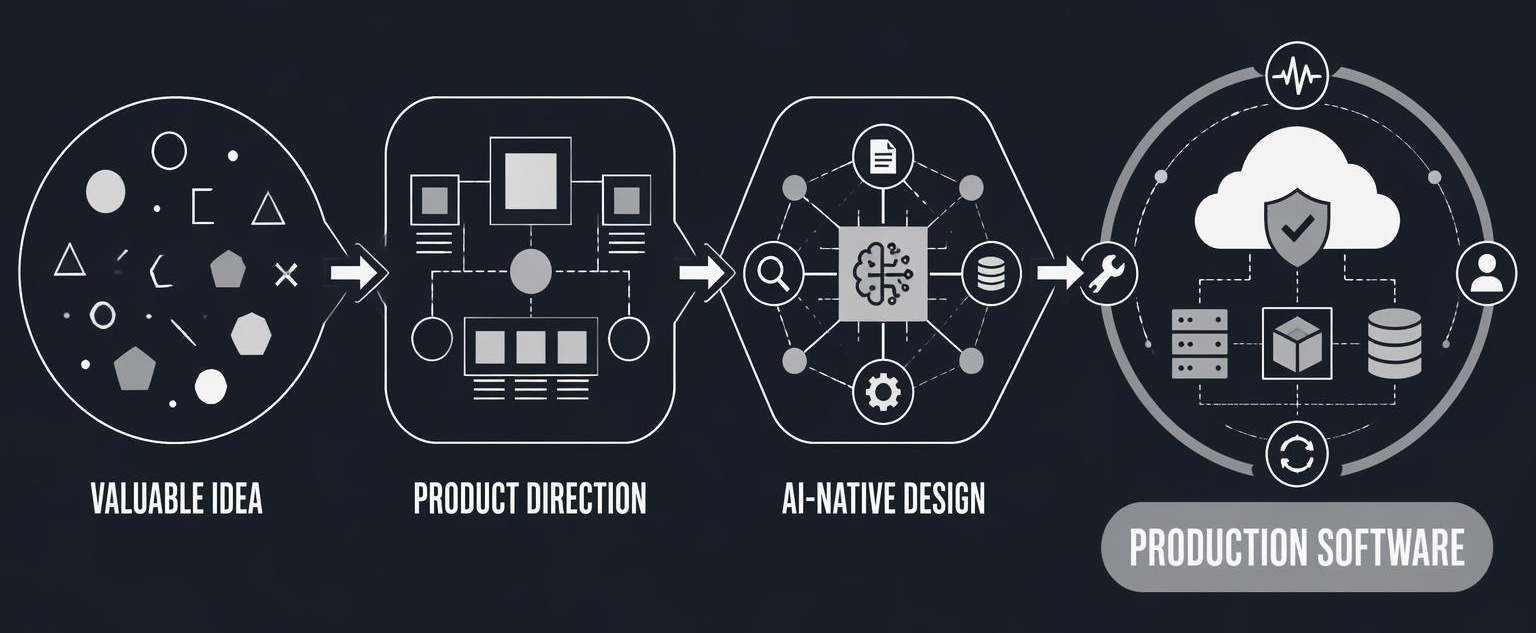
The target is production-quality software that can serve real users, evolve with the business, and receive ongoing care, not merely a prototype that proves an idea can be shown.
A demo can validate a concept or open a conversation. Production software must do more. It has to handle the ordinary, unglamorous realities that determine whether users trust it: data moving through the system, failures being understood, changes being made safely, and operational responsibilities continuing after launch. No magic. Just the work that makes a product usable after the presentation ends.
AI-native design brings the same discipline. A retrieval-augmented approach may fit when a product needs answers grounded in a defined body of information. Automation may fit when a repetitive decision or workflow can be made more useful. GPU-backed capabilities may fit a compute-heavy experience. None of these patterns is a default feature checklist. It can be tempting to treat the newest capability as a requirement. But that assumption needs correcting: if the AI does not improve the product’s actual value, it adds complexity without earning its place.
Cloud-native practice is similarly practical. AWS or Azure, serverless architecture, and GPU resources are available tools, not technologies every founder must adopt. The relevant question is whether the technical foundation supports the product’s operational needs and future changes without creating needless machinery.
The portfolio signals the breadth this requires. Inkflare includes multi-model AI workflows and GPU-powered video generation. ArchiveIT has operated as a document-management service for 15 years. Agile Clouders has also worked on healthcare systems in regulated settings. These are not interchangeable projects, but they point to the same principle: AI ambition and engineering discipline must be designed together from the beginning.
The bridge from an uncertain idea to that standard is not a rigid process diagram. It is sustained judgment and accountability.
The Bridge: Strategy Before Code, Senior Accountability Through Growth
A credible bridge connects product judgment to the people who will build and maintain the product. It starts by clarifying what should be built and why, establishes a realistic product and technical direction, and continues through implementation, production, maintenance, or modernization as needs change.
Direct principal involvement reduces the distance between a consequential decision and its technical execution. It also makes advisory more useful when it is written, specific, and defensible rather than decorative. A founder needs a recommendation that can withstand scrutiny, not a vocabulary lesson.
Agile Clouders operates in that model through Engineering Principal-led product development, advisory, product discovery, and maintenance. The fit is not universal. It is for founders making a meaningful product bet who value senior judgment and production readiness. It is not the natural fit for a team seeking the cheapest feature throughput or a superficial AI add-on.
Choose the partner that can help determine the right product, then accept responsibility for building it into a durable system. If that is the decision in front of the company, start a product conversation with Agile Clouders. The sharper question is not who can build the first version. Who can still stand behind it when the first version becomes the business?