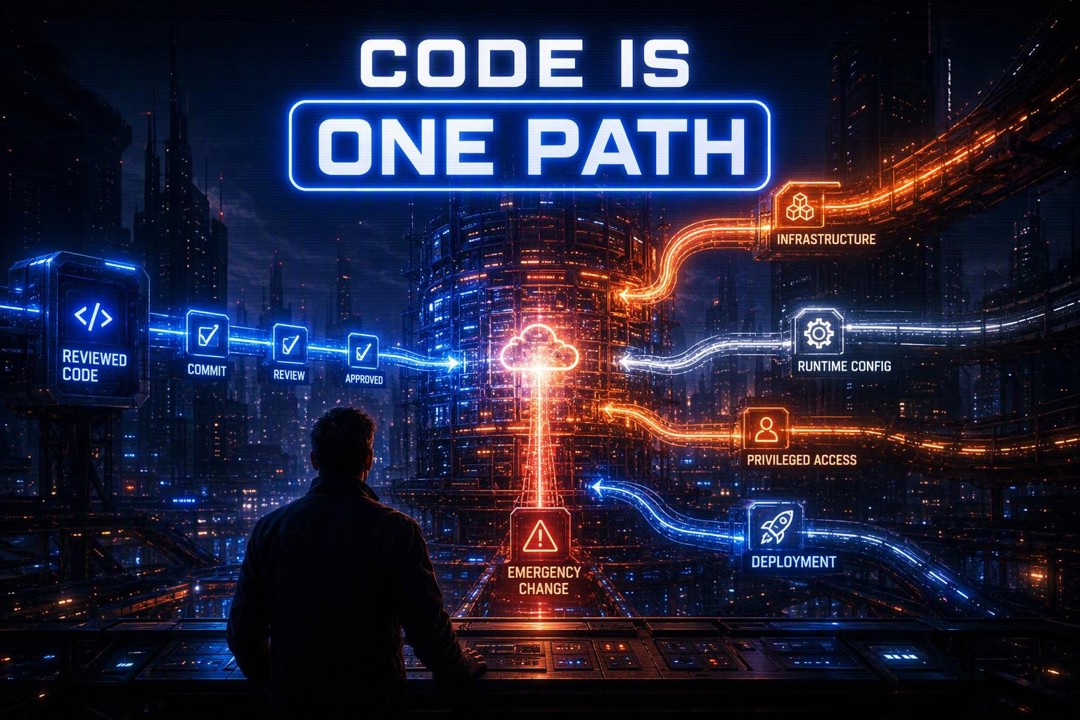
Protected branches and reviewed pull requests are strong evidence that application code is reviewed before merge. They do not automatically prove that every production-affecting change is authorized, traceable, and recoverable. A SOC 2-ready change-management approach maps the real ways the live system changes, then applies practical controls to each path.
That distinction catches many startups off guard. The repository may be disciplined while a production environment can still change through a cloud console, a deployment variable, a permission update, or an urgent command. The question becomes: can the team show how each of those changes is controlled?
Why can a clean GitHub workflow still leave a SOC 2 gap
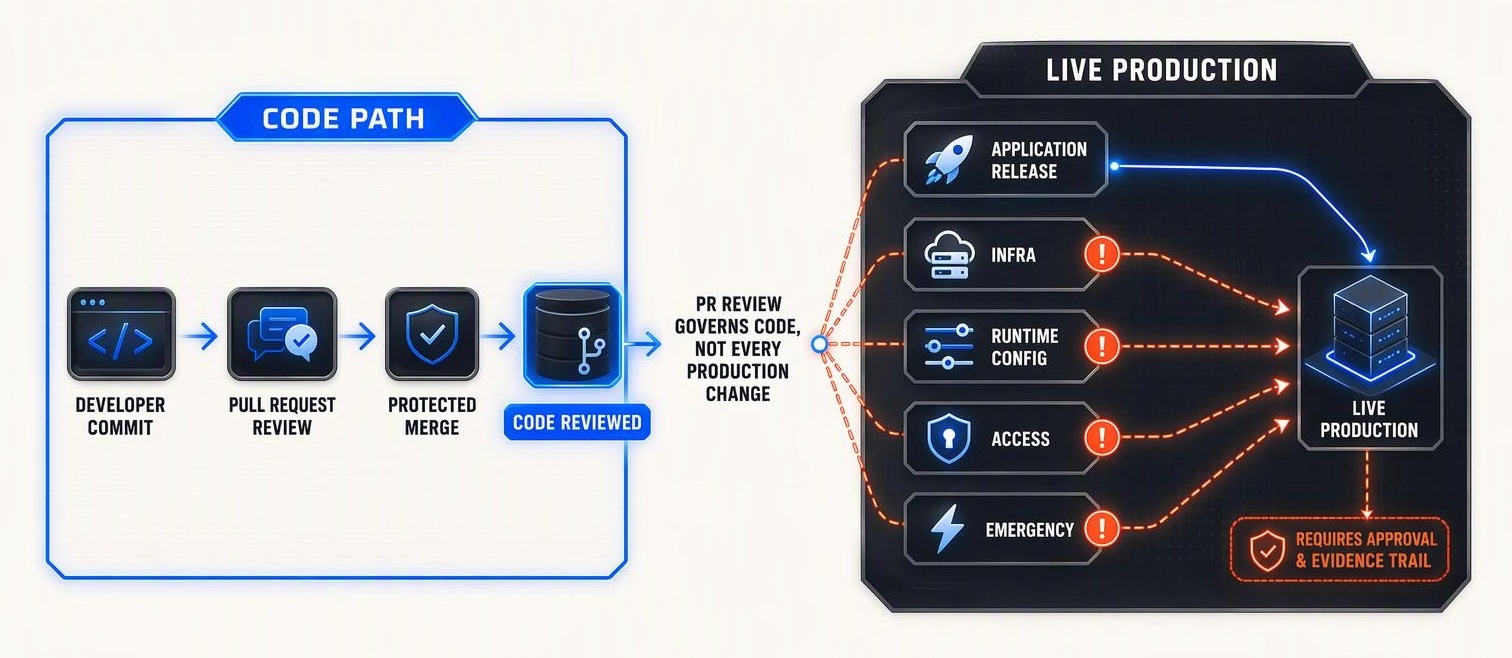
A clean GitHub workflow controls source-code changes, not automatically the full production environment. Required reviews and protected branches can establish who approved a code change before it merged. But they may not cover a new firewall rule, an altered secret reference, a feature flag switched in production, or an administrator granting a privileged role.
The gap is not that pull-request review is weak. It is that it proves something narrower than teams often assume. A change-management control is complete only when it covers the actual routes that can alter production, including routes outside the application repository.
Which production changes need a traceable control path
Production change management should account for each category that can change what customers experience or what the system can access:
- Application code and database migrations: Link the change to its review, release, and rollback or recovery approach.
- Infrastructure: Treat networking, compute, storage, and managed-service changes as production changes, whether they are made through code or an administrative interface.
- Deployment and runtime configuration: Capture changes to secrets references, environment variables, feature flags, scaling settings, and related release settings.
- Access-related configuration: Record changes to privileged roles, service permissions, and other access that can alter the production security boundary.
- Emergency changes: Use a defined exception path rather than allowing urgency to create an invisible path around the process.
The mechanism does not need to be identical for every category. The record should still make it possible to identify what changed, who approved it, who performed it, when it occurred, and how the team can investigate or reverse it.
How do teams connect cloud and deployment changes to approvals
Teams connect cloud and deployment changes to approvals by designing a trail that fits the engineering stack, rather than forcing every action into manual paperwork. Infrastructure as code can inherit pull-request review, commit history, and deployment logs. A controlled CI/CD pipeline can connect a release to a commit, approver, target environment, and deployment result.
Console access needs its own answer. Restrict standing production permissions, log administrative activity, and document the review path for permitted exceptions. A console change is not automatically uncontrolled, but it should not depend on someone remembering later why it happened.
A useful application of this model is a reconstruction test: choose one production change and ask whether the team can recover the request, approval, execution record, and resulting evidence without relying on memory. Agile Clouders approaches SOC 2 readiness by embedding controls in the actual technology stack, rather than treating documentation as a substitute for operating controls.
What should an emergency production change look like under SOC 2
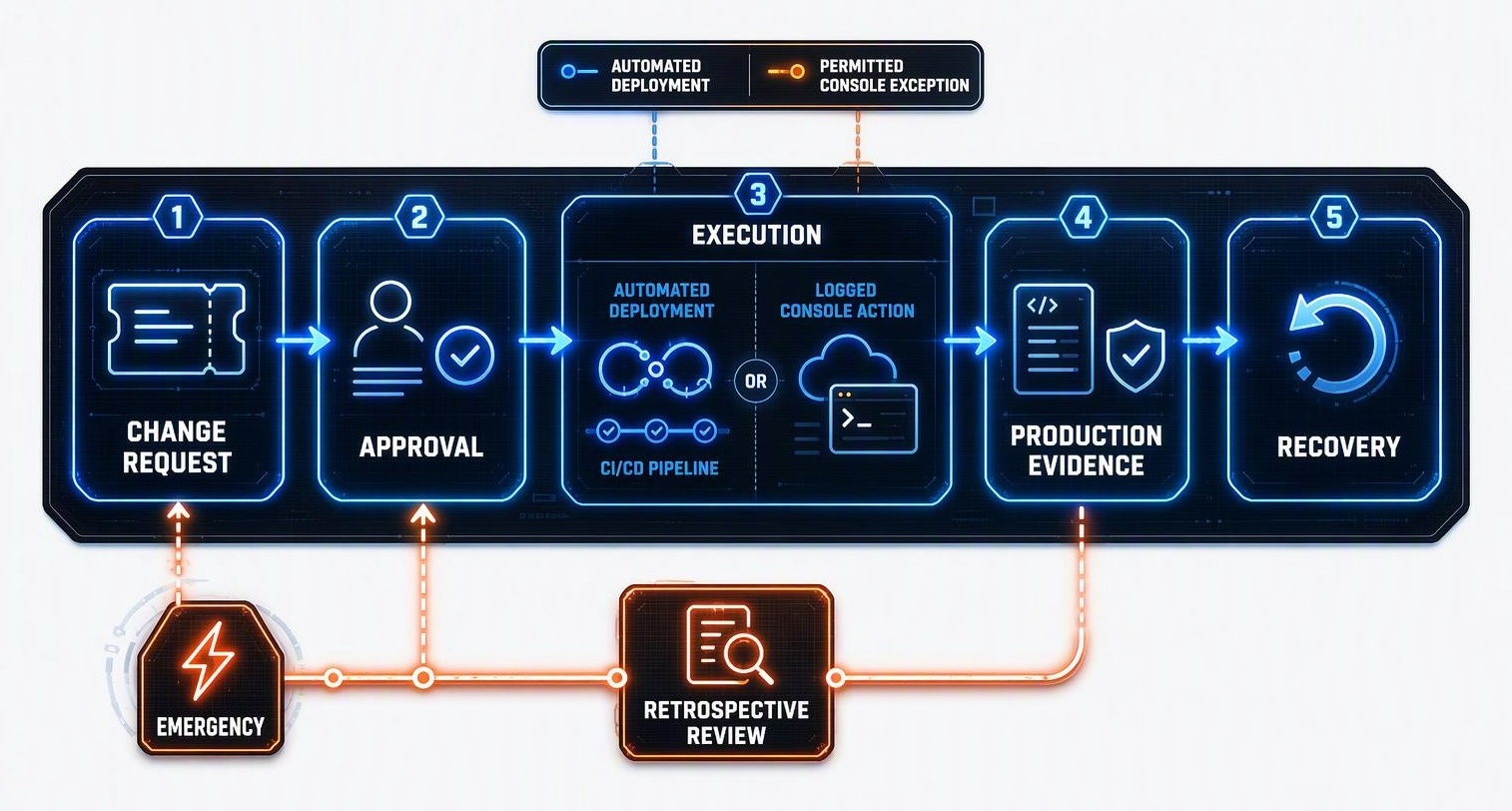
Emergency changes can require action before normal approval occurs, but urgency does not remove accountability. A lightweight emergency path should limit authorized access, log the actions taken, capture the reason for the exception, and require prompt retrospective review.
The follow-up should move any durable fix through the normal workflow. The useful question is not whether emergencies ever happen. It is whether an exception remains visible, reviewable, and correctable after the incident.
Production change management is a map of reality
The aim is not to treat GitHub controls as the whole answer or to add paperwork around every operational action. Inventory every route that changes production, then identify its owner, approval point, evidence source, exception path, and recovery path.
Success is a control description that matches how production actually changes.