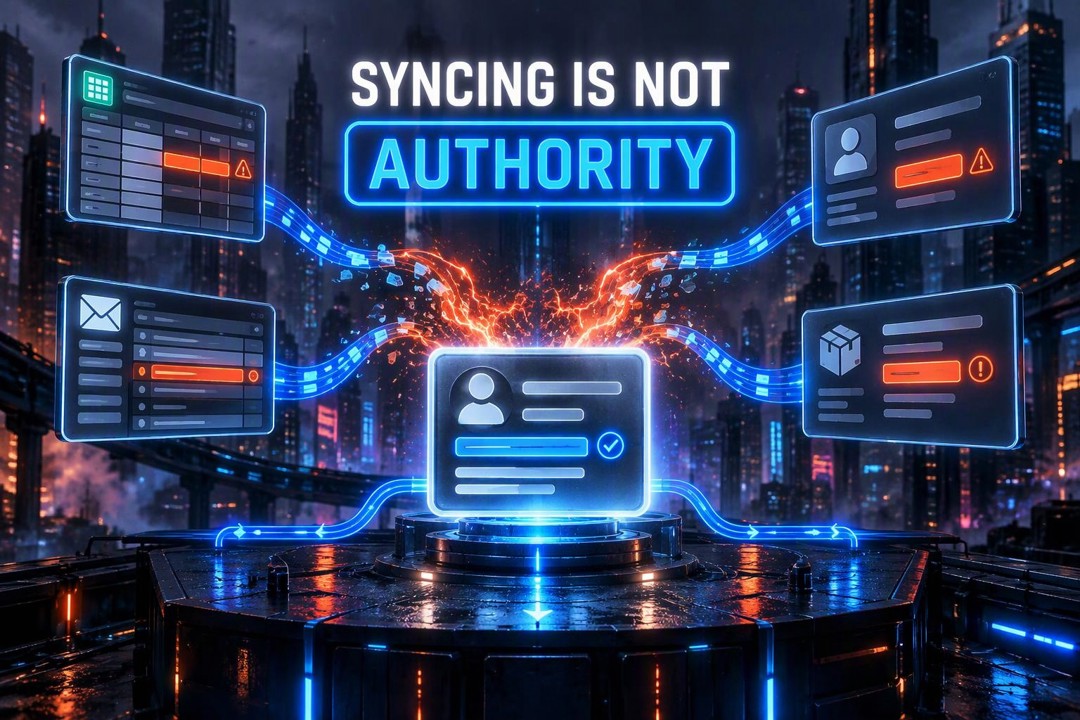
Connecting a spreadsheet, inbox, CRM, and operational system can remove manual copying while making disagreements travel faster. Synchronization moves data, but it does not decide which record is correct. Before integrating, assign authority for each important record, name the person or team that resolves exceptions, and define how the corrected value returns to affected systems without creating duplicates.
That sounds like administration before engineering, but it is a product decision. A fast integration can distribute the wrong customer status, price, or order detail before anyone notices the original disagreement.
Why does syncing data not establish a source of truth
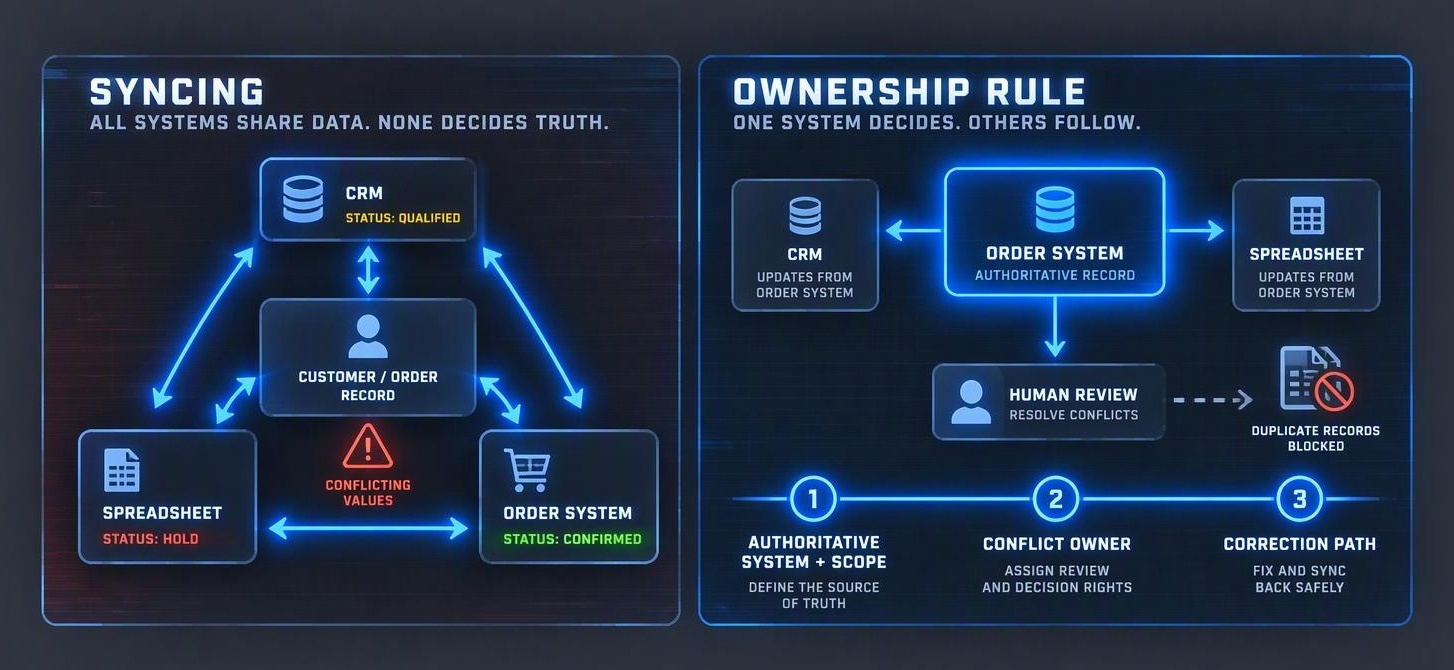
Syncing data does not establish a source of truth because it transfers changes without judging their business meaning. Imagine sales changes a customer status in the CRM, operations updates a spreadsheet, and finance relies on an order system. Each update may be reasonable in context, yet the systems now describe different realities.
An integration can copy all three changes quickly. It cannot know whether a sales note should override a fulfilment state or whether the operational system should reject an outdated status from the CRM. Movement is not authority. The decision rule is simple: do not automate a field until the business can name its authoritative home.
What must every important record ownership rule define
Every important record needs an ownership rule that defines authority, exception handling, and recovery. Ownership may change by record type or stage. A CRM can own sales qualification, while an operational system owns fulfilment status after an order is confirmed.
Before an integration enters the roadmap, document three checks:
- Authoritative system and scope: State where a confirmed value lives and when that system becomes authoritative. For example, define whether confirmed order status belongs in the order system rather than in a sales pipeline.
- Conflict owner: Name the person or team that investigates competing updates, unclear states, or records that cannot be matched confidently.
- Correction path: Define how the resolved answer is written back to every system that needs it, including how the process prevents a second customer or order record from being created.
The practical check is to name the owner, the exception, and the recovery path. If the team cannot do that, a synchronization rule is likely automating an unresolved business question.
How can automation make a disagreement worse
Automation makes a disagreement worse when competing updates reach downstream systems before anyone can resolve which one should win. A salesperson may change a customer request while operations changes the shipment state. If both updates flow across connected tools without precedence rules or a review path, a stale or incomplete value can overwrite the record another team relies on.
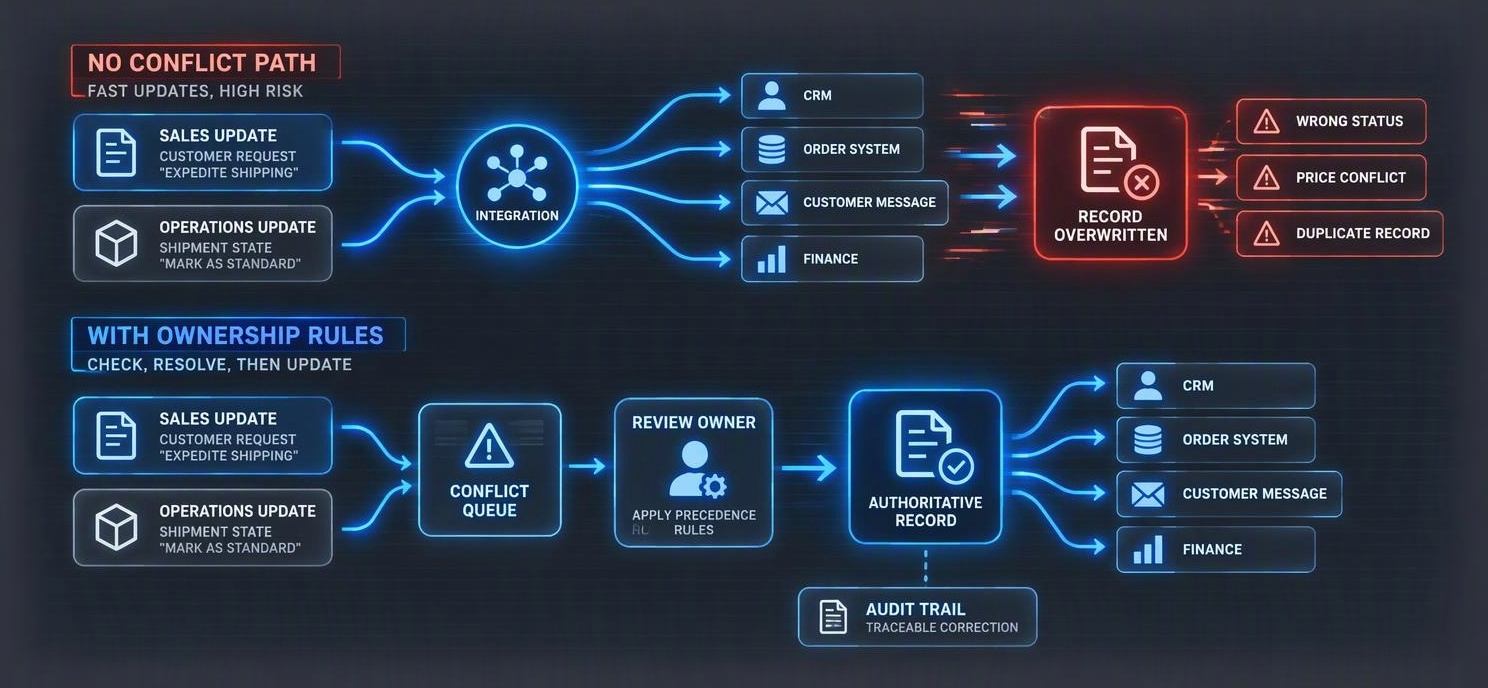
The result is not merely messy data. It can produce duplicate customer records, conflicting prices, incorrect status messages, and silent corrections with no clear explanation of what changed. Those failures are difficult because each individual system may appear to have saved a valid update.
Integration is not the problem when the ownership model is clear. The problem is treating speed as proof of correctness. A useful application does more than move a value from one screen to another. It preserves the business decision behind that value when systems, people, and timing disagree.
What should be decided before an integration enters the roadmap
Source-of-truth decisions belong in product discovery before major technical commitment. Start by mapping the completed business job, such as receiving an order, confirming fulfilment, and notifying the customer. Then identify the records that job depends on and decide where each disputed value is resolved.
A broader integration may be appropriate, but it does not automatically justify connecting every tool. The smallest useful improvement might be clearer process guidance, a shared tool, a targeted custom component, or a limited integration around one dependable workflow. The question becomes which decision must remain correct for the business outcome to hold.
The aim is not to connect every system. It is to make one business outcome dependable. Success is observable when the team can explain where a disputed record is resolved and how the corrected answer reaches every system that needs it.