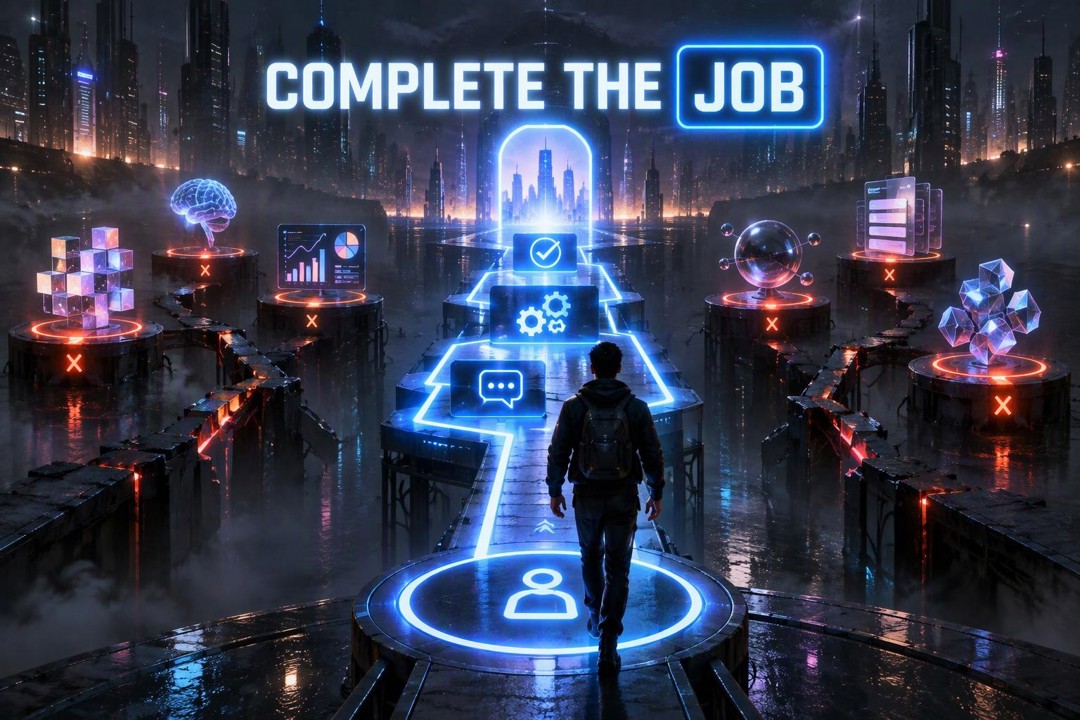
A startup can launch its most requested features and still learn almost nothing about customer demand if users cannot complete the real job that made those features relevant. An MVP is not the shortest feature list. It is the smallest end-to-end workflow that moves a specific user from a real trigger to a valuable, observable outcome.
That distinction changes what “small” means. A product can look polished in a demo, include search, dashboards, and notifications, and still send users back to spreadsheets or email to finish the work. The aim is not to preserve every capability. It is to protect the workflow that proves whether the product matters.
What makes an MVP useful enough to validate demand
A useful MVP lets a customer finish one meaningful job, even if the experience is narrow and some work happens manually behind the scenes. Think of it as a thin vertical slice: one user, one situation, one path through the work, and one result they can recognize.
A reduced feature list is different. It collects individually sensible functions but leaves a gap between starting the task and reaching its outcome. Prospects may have asked for those functions because they are visible annoyances, not because each function alone solves the underlying problem. Requested features are inputs to discovery, not proof of product value.
The practical principle is simple: protect the workflow, not every capability around it. If a user can complete the job without returning to their old process, the release can test behavior rather than just collect opinions.
Why do isolated features create misleading MVP feedback
Isolated features can earn praise while hiding the fact that the core customer problem remains unsolved. Imagine a purchasing tool that lets an employee create a request and search a catalog, but cannot route the request to an approver or confirm that an order was placed. The screens may work perfectly. The purchasing job does not.
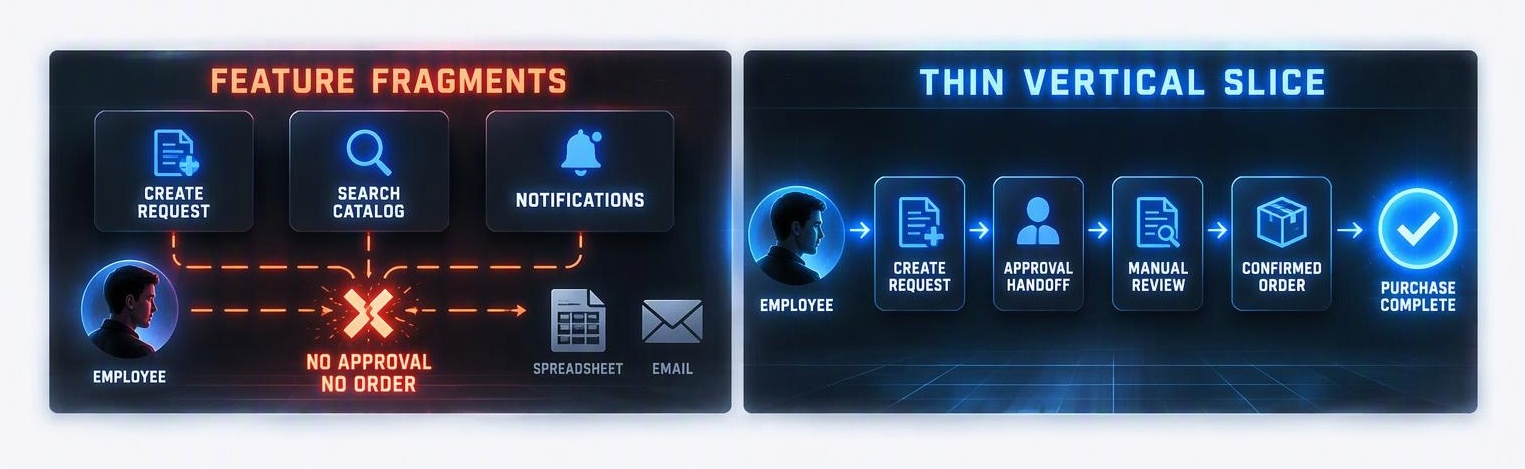
That release can produce flattering but weak signals: users like the interface, ask for more integrations, or try it once. None establishes that they will change how they buy. The missing approval, handoff, decision, or confirmed result is often where the product hypothesis is actually tested.
A useful application is judged by the work it helps someone complete or review. When a required step is absent, feedback tends to describe what users wish the product did, rather than whether the product changed their behavior. That is expensive ambiguity for an early release.
How do you define the minimum end-to-end user job
Define MVP scope by mapping the job before estimating features. The question becomes: what must remain for this user to complete the task without reverting to another system?
- Trigger: What event starts the work, such as a request, deadline, or incoming record?
- Essential steps: Which actions are necessary to move from that trigger to a result?
- Owner: Who performs each step and accepts each handoff?
- Exception: What likely failure, missing information, or rejection must the user recover from?
- Observable outcome: What proves the job is complete, such as an approved request, sent document, or resolved case?
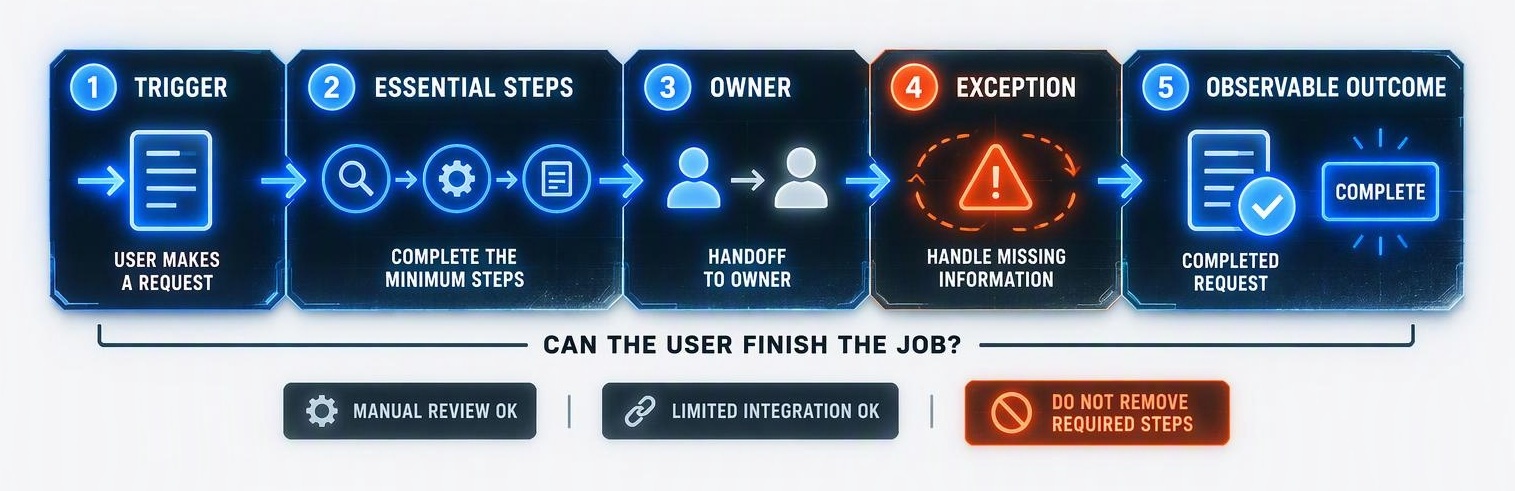
Each element does not require full automation or enterprise-grade polish in version one. An internal operator can perform a manual review. A limited user role can replace a broad permissions system. A temporary import can stand in for an integration. What cannot disappear is the customer’s ability to reach the outcome.
Choose a vertical slice over feature fragments
When scope is tight, choose between several disconnected features and one narrow workflow that reaches a real result. The vertical slice is usually the stronger test because it creates evidence: a user began the task, completed it, and received value.
Manual operations, constrained roles, limited integrations, and explicit workarounds are acceptable when they preserve that outcome. Removing a required workflow step is different from postponing a supporting feature. One keeps the learning intact; the other breaks the experiment.
The right roadmap question is not, “Which features fit in the first release?” Ask, “Can the intended user finish the job?” Success is not that a feature works. It is the completed task and the evidence of value it produces.