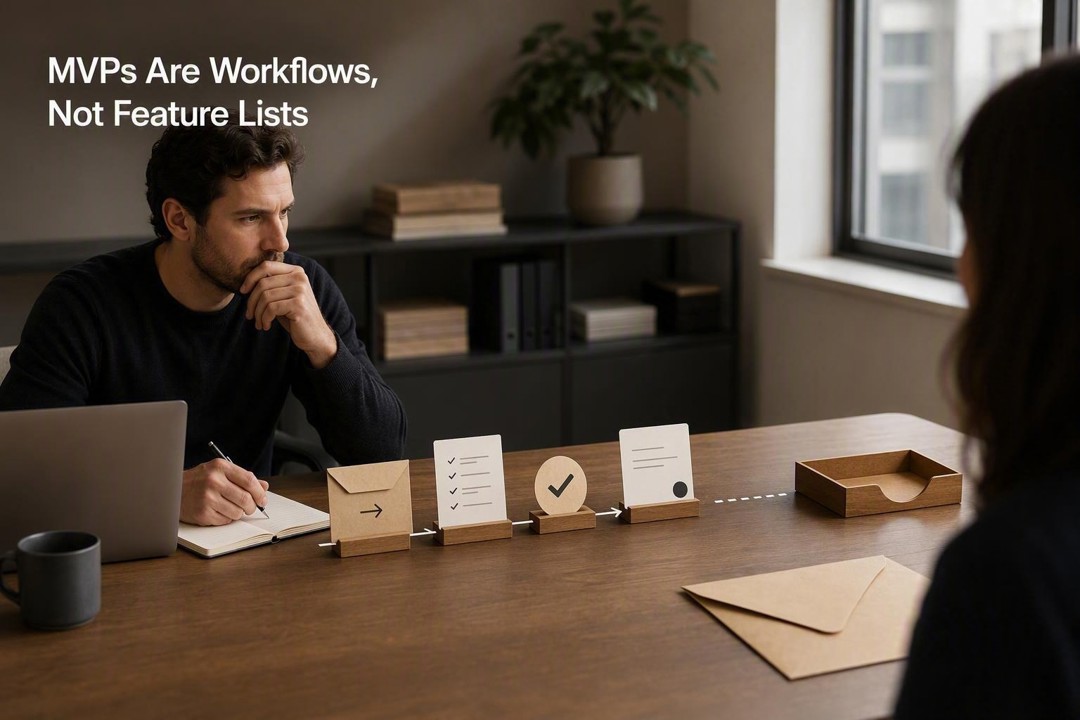
A team can build every feature it called essential for an MVP and still fail the first customer because the features do not complete a usable workflow. A viable MVP lets one specific user move from a real trigger to an intended outcome, with the information, action, recorded result, and handoff or exception path needed to finish the job.
That is the surprising part: a product with fewer screens is not automatically narrower in the way that matters. If the customer has to email someone, open a spreadsheet, make a phone call, or switch to another system to obtain the promised result, the core product test has been interrupted. The first version may use manual operations behind the scenes, but the customer should be able to finish the core job within the experience you provide.
Why can a feature-light MVP still fail the first customer
A feature-light MVP fails when its short feature list leaves a break between starting a job and completing it. Teams often scope from a backlog: create a form, save a record, add a dashboard, then call the list an MVP. Each item can work in isolation while the customer still arrives at a dead end.
Consider a customer who submits a service request. They can enter the details and press submit, so the team considers the request feature complete. But if no one receives the request, the customer cannot see whether it is being handled, and there is no way to respond when key information is missing, the customer has not actually received a service outcome. They have only produced data.
Viability is therefore not a count of screens, fields, or tickets. It is the ability to make and keep a small, credible customer promise. A request product promises more than submission. It promises that a request can lead to a response, resolution, or clear next step.
What makes an MVP viable
A viable MVP is the smallest end-to-end workflow that enables a specific user to achieve and recognize an intended result. It preserves the first complete loop of value, even when much of the operation behind that loop is still manual.
For a workflow to be complete, it needs five elements:
- A real trigger: the event that starts the job, such as a customer needing help, a document arriving, or an approval being requested.
- Necessary information: the details required to make a useful decision or perform the next step.
- A user action or decision: something the customer or operator can do that advances the job.
- A recorded or delivered outcome: proof that the result happened, such as a confirmed booking, an approved request, a completed task, or a visible status.
- A workable handoff or exception path: a way to transfer responsibility or recover when information is missing, a request is rejected, or the normal path cannot continue.
The final element is where many MVPs quietly fail. Real work rarely follows a perfect path. A simple exception process is enough at first, but there must be a process. If a user cannot tell what happened next, correct a problem, or get the work to the responsible person, the product has not supported the job it set out to test.
How does a feature-list MVP differ from a complete workflow MVP
A feature-list MVP starts by asking, “What is the fewest set of features we can build?” A complete workflow MVP starts by asking, “What must happen for this user to finish the job?” The first approach optimizes inventory. The second protects an outcome.
Take a service-request product. A feature-list version might include account creation, a request form, and a confirmation screen. It looks contained and may be quick to demonstrate. Yet it does not establish whether customers can get service, because the request stops after submission.
A workflow MVP might include the same form, a simple confirmation, and a visible status page. Behind the scenes, an operations person receives requests in a shared inbox, assigns them manually, and updates the status. This version may have an extra screen and an internal routine, but it is narrower where it counts: it tests one complete promise, from request to response.
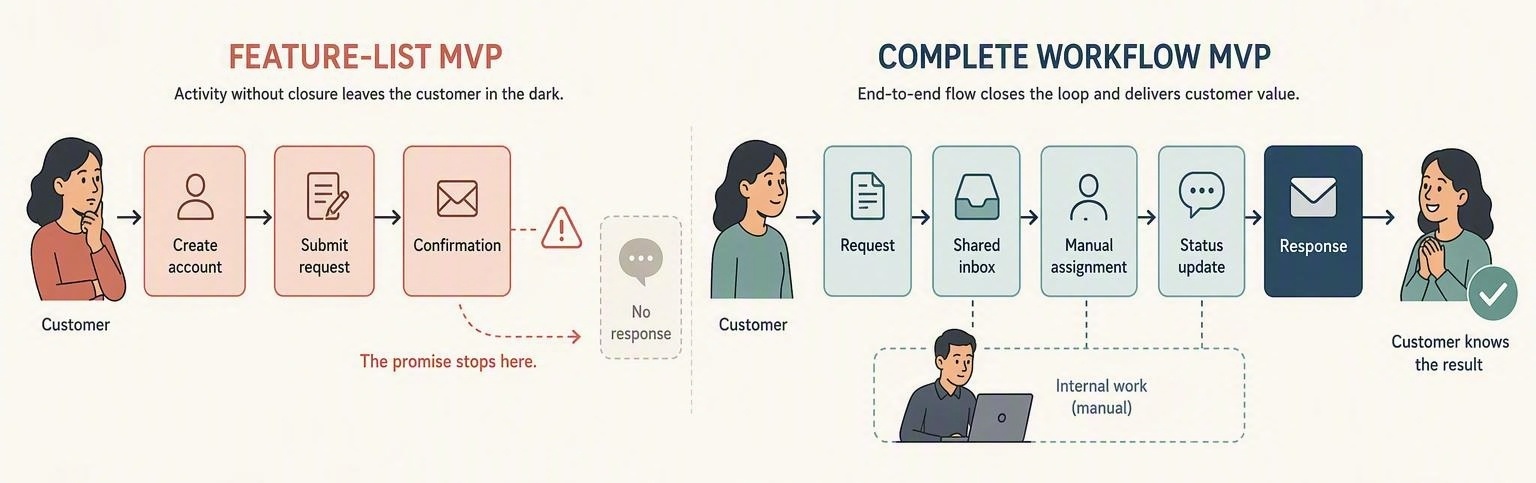
The distinction becomes clearer when the two approaches are compared:
| Feature-list MVP | Complete workflow MVP |
|---|---|
| Begins with a reduced backlog | Begins with one customer outcome |
| Treats submission as the endpoint | Treats the delivered result as the endpoint |
| May leave ownership between teams undefined | Preserves every necessary handoff |
| Can produce activity without customer value | Produces evidence that the customer’s job was completed |
| Often exposes gaps only after launch | Makes the first operational constraints visible early |
The workflow version is not a claim that everything must be automated. It is a decision to make the product testable with real behavior. It reveals whether the customer wants the outcome, whether the team can reliably deliver it, and where the operation begins to strain.
Which parts of an MVP workflow can remain manual
Internal automation can remain manual in an MVP when manual work reliably completes the customer promise within the experience the customer expects. This is one of the most useful ways to reduce scope without breaking viability.
A team can often defer automated routing, third-party integrations, reporting, self-service administration, advanced permissions, elaborate notifications, bulk actions, visual polish, and secondary user roles. An operator can route requests from a shared inbox. A founder can review a queue each day. A support person can update a status by hand. Those workarounds can be appropriate because they happen behind the product boundary.
The boundary is simple: the customer should not have to perform the workaround. If the customer must export data to finish the task, contact staff through a separate channel to obtain the result, or use a second product for the essential final step, the product is no longer testing its own core workflow.
Manual work also needs an owner and a service expectation. “We will handle it manually” is not a workflow unless someone knows what arrives, who acts on it, how they respond to exceptions, and when the customer sees the result. The goal is not to imitate scale before it exists. The goal is to deliver a dependable first outcome while learning which internal steps deserve automation.
This distinction fits a production-first mindset: operational readiness is part of onboarding real customers, not a concern to postpone until after a polished demo.
How do you find the smallest complete customer outcome loop
Find the smallest complete customer outcome loop by mapping one user’s path to one finished result, then removing only the work that does not affect completion. Start with the job, not with a proposed feature list.
Name one target user and one job
Be specific enough to make tradeoffs. “A facilities manager needs to get an urgent repair assigned” is more useful than “users manage maintenance.” A broad audience produces a broad MVP because every variation appears essential.
Identify the real-world trigger
Ask what event creates the need. A broken fixture, an incoming document, a missed payment, or a request for approval is the beginning of the loop. This keeps the workflow connected to behavior rather than to a screen someone hopes users will visit.
Map the current path to a finished result
Follow the work from trigger to completion, including people, decisions, systems, and waiting points. The existing process may be messy, but it reveals what must happen for the job to be considered done.
Mark the moment the user knows the problem is solved
This is the outcome that matters. It might be an appointment confirmed, a document accepted, a payment received, or a request resolved. If the product cannot create or clearly communicate this moment, it is not yet an outcome-producing MVP.
Identify handoffs, dependencies, and likely exceptions
Ask who acts next, what information they need, and what happens when the normal path fails. Missing details, declined requests, unavailable staff, and duplicate records are not edge cases if they stop the first customer from finishing the job.
Remove everything that does not change completion of the first loop
Apply one test to each scope cut: Can this user still complete the core job and know the result without leaving the product? If the answer is no, the step is foundational. If the answer is yes, it may be manual, postponed, or removed.
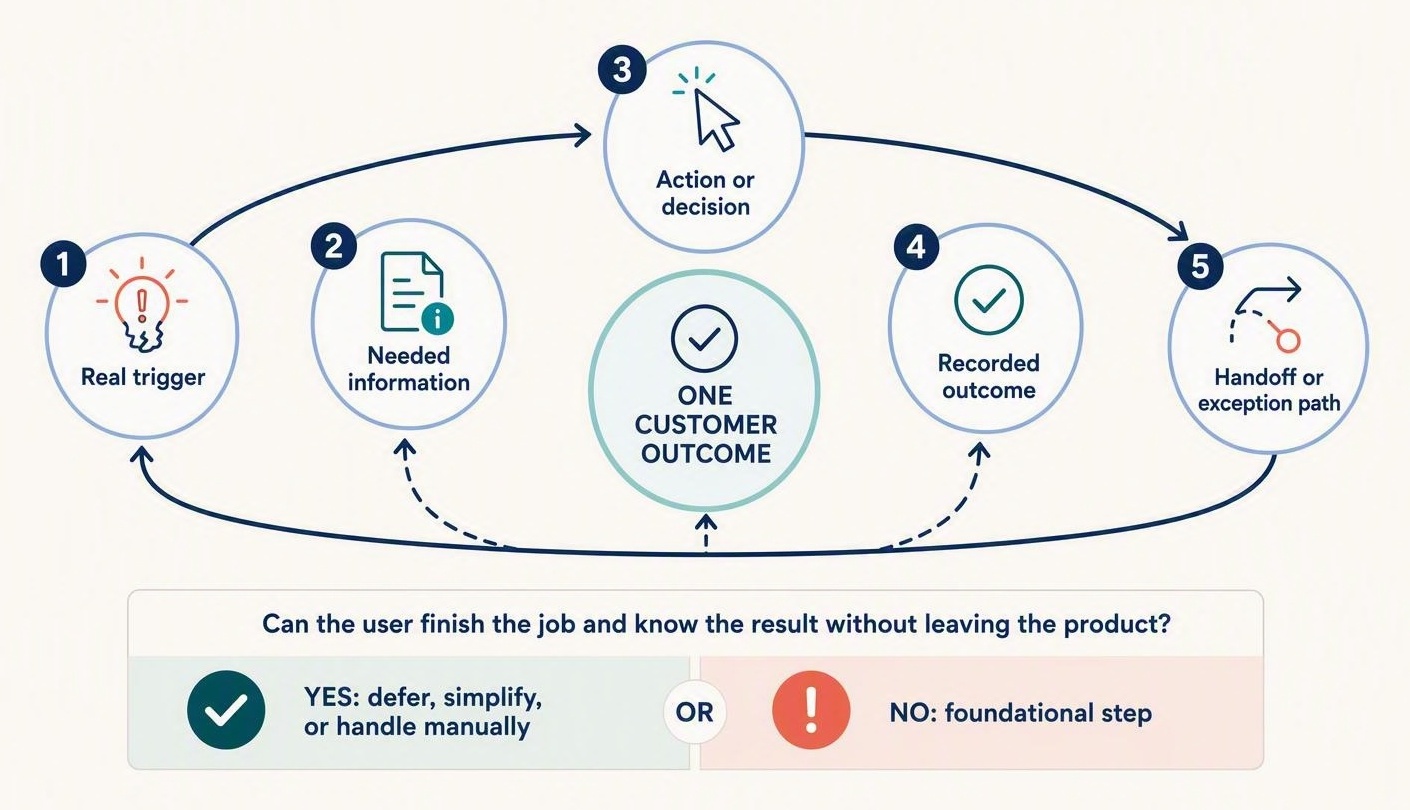
This method changes the scope conversation. Instead of debating whether a feature feels essential, the team asks whether removing it breaks the path from trigger to recognized outcome. That is a concrete question product, engineering, and operations can answer together.
How should workflow completion guide MVP roadmap tradeoffs
Use workflow completion as the rule for MVP roadmap decisions: prioritize anything that preserves the smallest credible customer promise, and postpone anything that only improves speed, scale, convenience, or breadth.
That means building the status update before an analytics dashboard when status is how the customer learns the job is moving. It means creating a basic path for missing information before adding advanced user roles when missing information can stop every request. It also means accepting a manual internal queue before building complex routing logic, provided the queue reliably produces the promised result.
A roadmap should not reward a low feature count if that count removes the one step that makes the product useful. Product discovery and roadmap shaping are most valuable when they clarify what to build first, what to postpone, and what to remove in service of a real business outcome.
The right MVP is not necessarily the product with the fewest features. It is the smallest version that lets a real customer finish the intended job and gives the team trustworthy evidence about whether the solution works.