What Founders Actually Need: And Why Just Shipping Code Fails At Scale
Speed without senior technical leadership doesn't save time. It just moves the cost downstream and compounds it, usually right around the moment funding is tightest and patience is thinnest. Every founder has heard the napkin-sketch story: an idea, a weekend build, a demo that gets funded, and then six months later a codebase nobody wants to touch. It's not a failure of ambition. It's a failure of sequencing, where output got mistaken for progress.
The stakes here are concrete, not abstract. Architecture debt shows up as a feature that takes three weeks instead of three days because nobody can safely change the code underneath it. Security gaps show up as a data breach notice, not a code review comment. Maintainability problems show up as the best engineer on the team quietly interviewing elsewhere because they're tired of firefighting someone else's shortcuts. And AI misuse shows up as a chatbot that hallucinates pricing to a paying customer.
What most founders get wrong about speed
The common mistake isn't moving fast. It's confusing tickets closed with risk reduced. The metrics that matter aren't output metrics at all. They're time-to-learning, meaning how quickly the product proves whether the idea works; reliability, meaning whether it holds up once someone finally notices it; and cost-to-change, meaning what happens when the next pivot touches the core instead of the edges.
This matters most for founders in one of four situations: turning a rough concept into a real MVP, inheriting a fragile first build from a contractor or early hire, running a funded team under investor pressure to ship faster than the foundation can support, or trying to modernize a legacy system without breaking the revenue it currently produces. In every one of those cases, the real job isn't writing code. It's reducing the odds that today's decision becomes next year's emergency.
The Hidden Costs Of Junior-Heavy Or One-Size-Fits-All Delivery
There's a specific kind of dread that sets in when a founder realizes the product "technically works" but nobody can explain why it works, or what happens if it stops. That feeling has a name in engineering circles: brittle. A deployment that only succeeds if it's run in a specific order, by a specific person, at a specific time of day, isn't infrastructure. It's a ritual. And rituals don't scale past the person who invented them.
Unclear ownership is the next symptom, and it's sneakier because it doesn't announce itself until something breaks. Three contractors touched the payments flow over eighteen months, none of them left documentation, and now a bug fix requires archaeology instead of engineering. No observability compounds this: without logs, metrics, or alerting, teams don't find out about outages from dashboards, they find out from angry customers on social media. That's not a technical failure. That's a trust failure, and trust doesn't come back at the same price it left.
Accidental complexity creeps in when every new feature gets bolted onto the existing structure instead of fitting into one. Insecure auth and data flows sit quietly until a security researcher, or worse, an attacker, finds them first. And increasingly, there's a newer failure mode: AI bolted onto a product without evaluation, meaning nobody actually tested whether the model's outputs are accurate, safe, or even legally defensible before it shipped to real users. Combine that with "vibe-coded" features, built fast on instinct with no tests and no clear spec, and the result is a product that can't be verified, only hoped for.
Each of these symptoms has a business cost attached, not just a technical one. Missed launch dates. Customer churn after a bad first experience. Middle-of-the-night incidents that burn out the one engineer who understands the system. And eventually, a rewrite, which is the most expensive form of admitting the first build wasn't built to last.
What AI-Native And Cloud-Native From Day One Really Means: And What It Doesn't
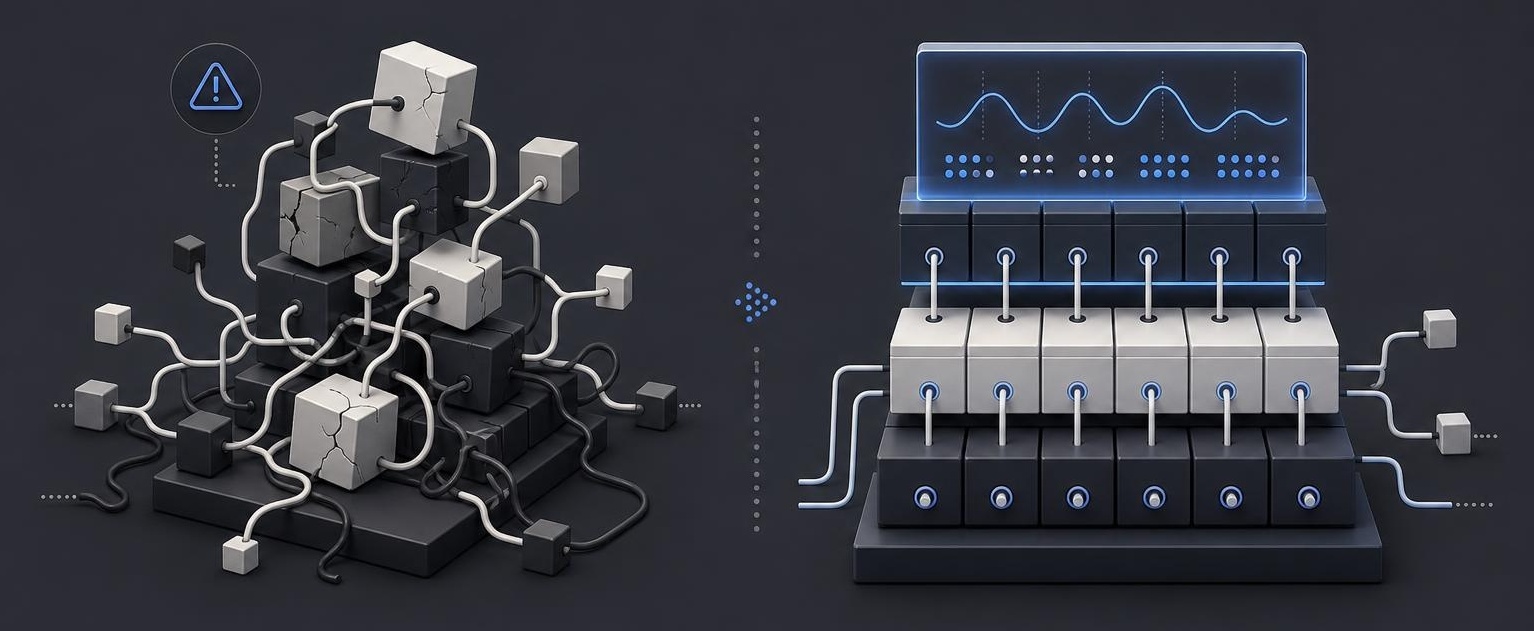
AI-native doesn't mean a chatbot widget in the corner of the screen. It means the product was designed with data readiness in mind from the start, so the information the AI needs is clean, structured, and actually available when the model needs it. It means the model or LLM was chosen deliberately, based on the task, the cost per call, the latency tolerance, and the risk of getting it wrong, rather than picked because it was the most talked-about option that quarter. It means there's an evaluation harness in place, a repeatable way to test whether outputs are accurate before they reach a real user, and guardrails that catch the moments when a model tries to answer something it shouldn't. Privacy and security controls, cost monitoring, and human-in-the-loop review for high-stakes decisions aren't extras here. They're the difference between AI that adds value and AI that adds liability.
Cloud-native is just as often misunderstood. Hosting on a major cloud provider isn't cloud-native, it's just cloud-hosted. Real cloud-native architecture means infrastructure is defined as code, so environments can be rebuilt reliably instead of hand-configured and half-remembered. It means CI/CD pipelines that catch broken changes before they reach production, not after. It means separate, properly isolated environments for development, staging, and production, with secrets managed deliberately instead of sitting in a config file somewhere they shouldn't be. It means observability that tells the team what's happening before customers do, resilience patterns that expect failure instead of being surprised by it, and clean boundaries between services so one broken feature doesn't take the whole product down with it.
Worth being honest about what this isn't. It isn't novelty for its own sake, adding AI features because competitors have them, not because customers need them. It isn't vendor lock-in dressed up as a strategic partnership, where every architectural decision quietly benefits one cloud provider's roadmap more than the client's. And it isn't over-engineering a system built for ten thousand users when the product currently has ten. The standard isn't "as advanced as possible." It's "as intentional as the stage requires," which is a much harder, and much more valuable, thing to get right.
A Practical Decision Checklist For Choosing A Senior-Led Product Partner
Most founders evaluate development partners on price and portfolio. Those are the two weakest signals available, because a slick portfolio shows what shipped, not what it cost to maintain afterward. A better evaluation runs through six areas: discovery and product thinking, architecture and engineering rigor, AI strategy and safety, the delivery system itself, communication and accountability, and what happens after launch.
On discovery, ask how the team decides what to build before writing a line of code, and how they'd handle disagreement with a founder's assumption. A partner who agrees with every idea instantly isn't being helpful, they're being agreeable, and those aren't the same thing. On architecture, ask for a concrete example of a scaling decision they made and what tradeoff it involved; vague answers about "best practices" without specifics are a warning sign. On AI, ask how they'd evaluate a model's output before it reaches a customer, and if the answer doesn't mention testing or guardrails, that's worth noting.
A few signals cut through the noise faster than anything else. Green flags: a small senior team that stays engaged post-launch, clear documentation as a deliverable rather than an afterthought, and a willingness to say "this isn't ready yet" even when a founder is eager to launch. Red flags: pricing based purely on headcount instead of outcomes, a team that disappears the week after go-live, and any AI integration pitched with more enthusiasm about the technology than clarity about what problem it solves.
Then again, the opposite mistake happens too: some founders get so cautious evaluating partners that they never commit to one, stuck comparing proposals for months while a competitor with a rougher but shipped product starts collecting real user feedback. The checklist isn't meant to produce paralysis. It's meant to produce a fast, informed yes or a fast, informed no.
How Agile Clouders Turns Ideas Into Scalable Products (Without Disappearing After Launch)
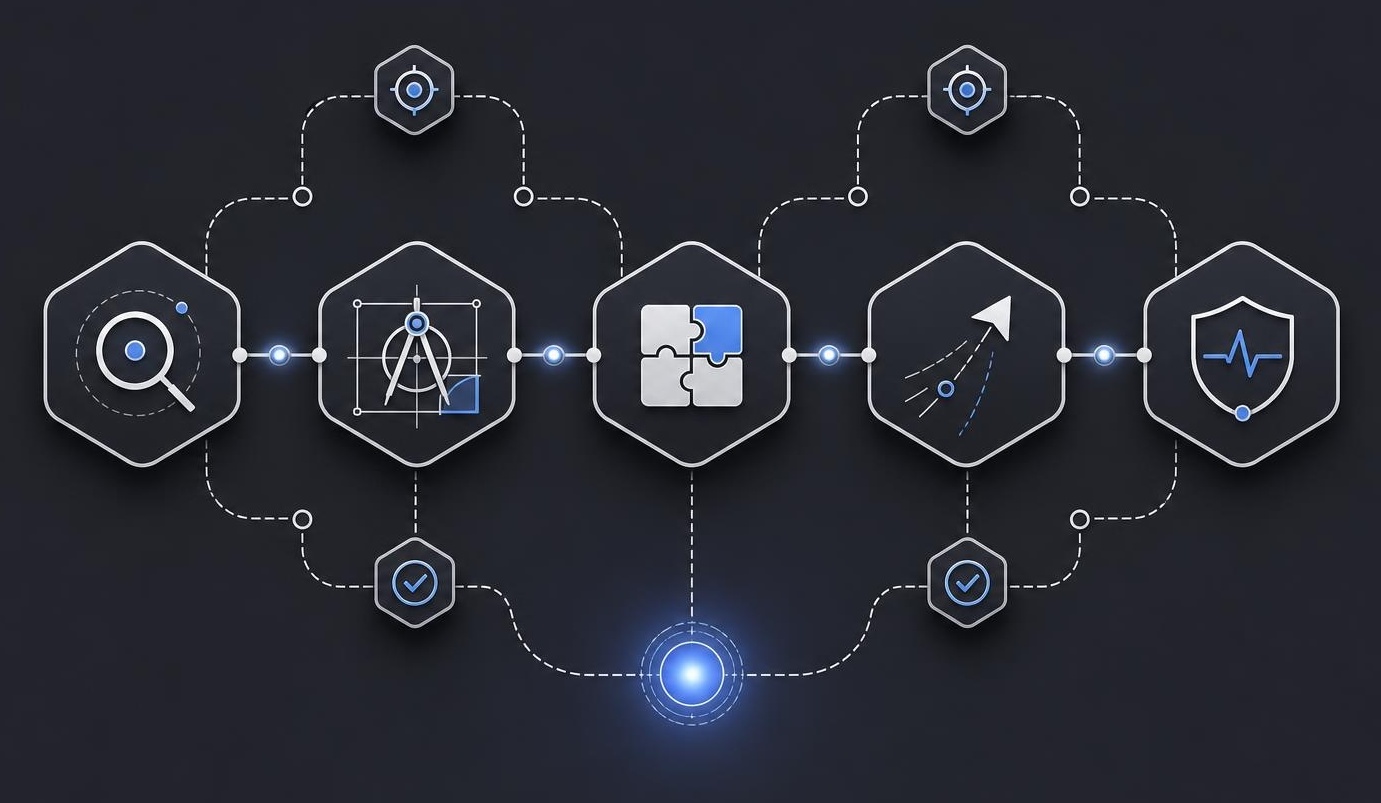
The lifecycle that actually works looks less like a handoff and more like a running conversation. It starts with concept alignment, making sure the technical plan matches the business goal before anything gets built. Discovery follows, mapping out what data exists, what the riskiest assumptions are, and where AI genuinely adds value versus where it would just add cost. Then comes the MVP build itself, done with production standards from the start rather than duct tape that gets "fixed later." In practice, later rarely comes.
Launch hardening is the step most rushed teams skip entirely: stress-testing the system, checking security before real customers show up, making sure observability is in place so problems get caught early instead of reported by users. Scaling and modernization come next, expanding what works and carefully replacing what doesn't, without breaking the parts of the system that are already earning revenue. And continuous improvement means the relationship doesn't end at launch, because the riskiest architectural decisions in any product's life often happen months after go-live, when growth reveals what the original build couldn't handle.
Agile Clouders operates as a senior-led boutique partner built around this exact lifecycle: a small, accountable team that thinks in terms of business outcomes, not just tickets closed, with technical leadership from Agile Clouders as Co-founder shaping decisions from day one rather than reviewing them after the fact. The point isn't to be the biggest team in the room. It's to be the one still answering the phone six months after launch, when the questions get harder and the stakes get higher.
For founders who suspect their current build has a fragile foundation, or who are staring down an AI feature they're not fully confident in, the useful next step usually isn't a full engagement. It's a focused architecture review or AI readiness assessment, something short enough to fit into a busy week but honest enough to surface what's actually at risk before it becomes expensive.
So the real question isn't whether the current product can ship fast enough to hit the next milestone. It's whether it can survive being right, because success that arrives on top of a fragile foundation tends to break it faster than failure ever would.