Start With the Product Job, Not the AI Capability
AI belongs in a product only when it materially improves a defined user or business job and the company can own the resulting data, operational, quality, security, and maintenance obligations. Otherwise, buy a bounded capability to test demand, or defer it until those responsibilities are clear. The decision is not a referendum on whether AI matters. It is a judgment about whether this particular feature will create durable value without creating a production commitment nobody is prepared to run.
Architecture debt is not merely messy code. It is the future constraint and operating burden created by an expedient decision: a data path with unclear rights, an output nobody can judge, a vendor integration without an owner, or a feature customers start relying on before it is reliable enough.
An AI feature is a system, not a model call. It has inputs, permissions, failure modes, evaluation, monitoring, support needs, and people who must respond when it gets something wrong. Most of a product’s life happens after launch. A convincing demo can hide every one of those obligations.
That is why product discovery should come before major investment. Agile Clouders’ advisory work is built around clarifying where AI genuinely adds value, then making explicit choices about what to build, buy, postpone, or remove. The useful question is not, “Can this generate an answer?” It is, “Does this improve a decision, workflow, or outcome enough to justify owning the whole system around it?”
Once the job is clear, assess the operating reality.
Use the Six-Dimension Matrix to Choose Build, Buy, or Not Yet
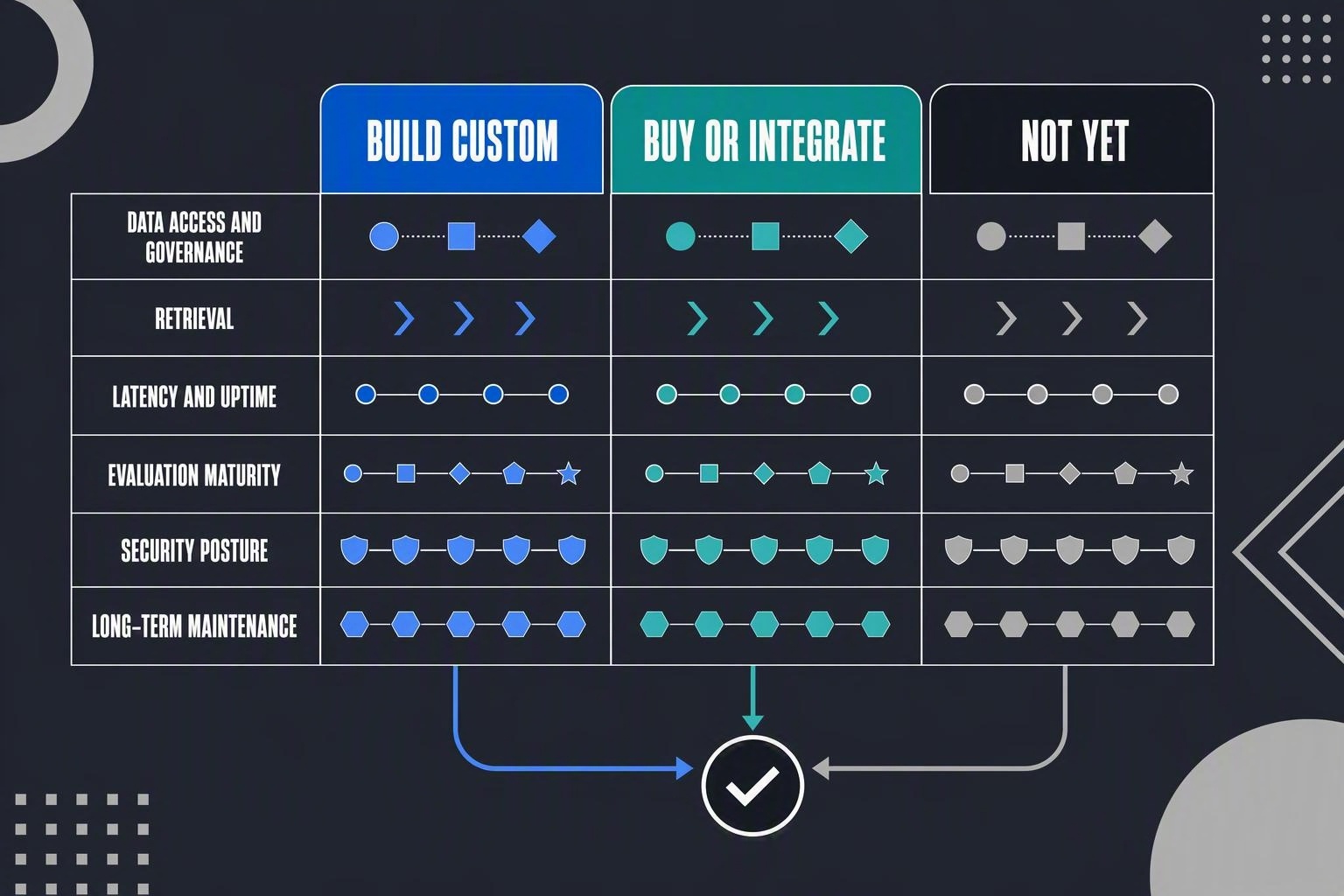
No single dimension decides the answer. A proprietary dataset does not rescue a feature with no quality standard. A polished vendor does not solve an unclear security boundary. Read the six dimensions together.
| Dimension | Build custom when | Buy or integrate when | Choose not yet when |
|---|---|---|---|
| Data access and governance | Differentiated workflows depend on proprietary, tightly governed data | The task uses approved, low-risk data with a clear vendor path | Data rights, retention, or access ownership are unclear |
| Retrieval | Product value depends on grounding answers in changing internal knowledge | Vendor retrieval meets a bounded need | No reliable source of truth exists |
| Latency and uptime | The feature needs product-specific control over performance and failure behavior | Standard response times and availability are sufficient | Service expectations have not been defined |
| Evaluation maturity | The team can define acceptable output and test it repeatedly | Vendor capability is easy to validate against a narrow task | Nobody can say what good, bad, or unsafe output looks like |
| Security posture | Permissions, audit needs, and data boundaries require tailored control | The intended data and vendor terms fit the company’s review process | Security ownership is unresolved |
| Long-term maintenance | The capability is strategic enough to justify sustained engineering ownership | Integration and operational burden are proportionate to the benefit | No owner or budget exists for post-launch operations |
Retrieval means grounding an output in relevant product or enterprise information, rather than asking a general model to guess from its training. It matters when a response must reflect a customer’s documents, current policies, or product-specific facts. Inkflare, for example, uses multi-model workflows and retrieval-augmented generation over vector search. That shows what a real AI product system can contain, not that every feature requires the same design.
Latency and uptime are product commitments. If a user needs an answer while completing a time-sensitive task, delay and failure become part of the experience. Evaluation maturity is equally concrete: can the team define acceptable answers, detect drift, and act when quality falls? If not, it cannot responsibly promise the feature.
What most people get wrong: they compare model cost with vendor price. The larger cost is ownership. It includes integration changes, data refresh, observability, prompt and workflow changes, incident response, and human review. The cheapest route to launch can become the most expensive route to own.
Then again, buying is not a lesser decision. For a standard, bounded workflow, a mature capability can validate demand without making the company responsible for custom infrastructure before users prove they need it. ArchiveIT’s independently operating 24/7 backend services and 15-year history make the broader point: production commitments outlast feature launches.
Red Flags That Mean Buy First, or Do Not Add AI Yet
A buy-first decision is often the disciplined move when the job is real but differentiation is not. Choose it when the capability is a commodity, the workflow is well bounded, an established integration exists, or the immediate goal is learning whether customers will use it. Buying limits the initial surface area. That gives product leaders evidence before they inherit custom evaluation and maintenance work.
Not-yet is different. It means the team cannot yet make a safe, testable promise. Watch for these signals:
- No defined user decision or workflow improvement
- No authorized, reliable data path or source of truth
- No criteria for acceptable output or known failure handling
- No ready security review for the intended data
- No named owner for operations after launch
Each signal maps back to the matrix. Unclear data rights block governance. Missing source material makes retrieval unreliable. Undefined response expectations make latency and uptime impossible to manage. No quality criteria means evaluation is theater. Unassigned security or maintenance ownership turns a roadmap item into an orphaned system.
The consequence is not abstract risk. Users receive inconsistent answers, support teams improvise, security concerns appear late, and engineering spends months stabilizing a feature whose customer value was never established. That is architecture debt arriving on schedule.
Agile Clouders’ product-discovery stance is useful here: clarify the product before significant investment, including what should be postponed or removed. Security readiness work also treats access management, change management, monitoring, vendor review, and evidence collection as operating practices, not paperwork added after the fact. This does not make an AI system compliant by itself. It does make ownership visible before the feature becomes hard to unwind.
Make the Decision Accountable for the Product’s Long Life
Turn the matrix result into a short decision record. This is not a permanent verdict. It is a clear statement of what the business is choosing to own, what it is deliberately not owning, and what evidence would change the answer.
Record the user and job, the chosen path, the data boundary, service and quality expectations, operating owner, maintenance commitment, and review triggers. A trigger might be validated demand that justifies custom work, a new data source that makes retrieval viable, or a security requirement that changes the vendor fit. Specific conditions prevent a temporary shortcut from quietly becoming permanent architecture.
Maintenance belongs in the original design decision, not in a cleanup phase after launch. Agile Clouders works across product discovery, launch, and ongoing maintenance, with written, defensible recommendations for consequential technical choices. When a high-stakes AI decision lacks an accountable technical owner, an Engineering Principal-led architecture or roadmap review can make the trade-offs explicit.
Choose the smallest accountable path to validated value. Custom AI is not proof of ambition. The stronger signal is knowing what your product must reliably do, who will own it when it fails, how the choice will be reviewed as conditions change, and whether building it remains the honest answer over the product’s long life for the customers and teams who depend on it.