
A startup can build requested MVP features and still discover too late that the product cannot work as planned. The roadmap measured visible progress, not the assumptions that determine viability. Before committing to feature delivery, test the conditions that could invalidate the concept or radically change its cost, scope, architecture, or timeline. The aim is not to delay building. It is to make sure the work being built is still worth building.
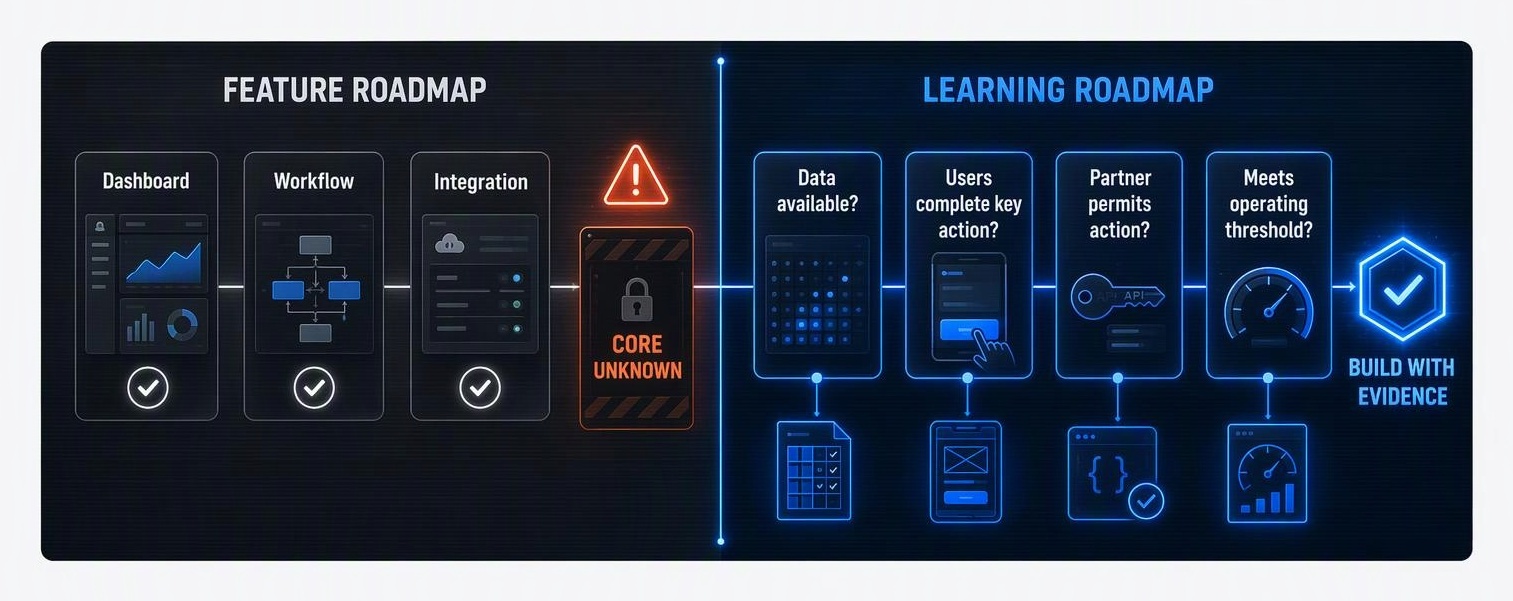
Imagine a team that has shipped a polished dashboard, workflow, and requested integrations. It looks like momentum, until the team learns customers cannot provide the needed data, or will not complete the one action the workflow depends on. Those features may be useful, but they did not answer the question that mattered first.
What could make your MVP roadmap irrelevant before launch
A feature roadmap organizes what the team intends to ship, while a learning roadmap organizes the evidence needed to justify shipping it. Both matter, but they answer different questions. A feature roadmap can show steady delivery while leaving the product's most consequential unknown untouched.
This distinction becomes important when easy-to-demo work is safer than the hard question. A settings screen, reporting view, or familiar integration may be straightforward to estimate and satisfying to show investors. But if the core workflow depends on a partner permission or a customer habit that has not been tested, that visible progress can harden the wrong plan.
Which assumptions can invalidate an early software product
Product-invalidating assumptions are conditions that, if false, force a fundamental change in the plan. They are not every risk on a backlog. They are the unknowns that can make later features irrelevant or substantially more expensive.
- Required data is available and usable. If the data is inaccessible, incomplete, delayed, or too inconsistent, the product may need a different workflow or no longer deliver its promise.
- Users will complete the critical behavior. If users will not upload information, approve a step, change a routine, or invite another person, the product's value loop may never start.
- A third-party system permits the needed action. If an API, platform policy, contract, or permission model blocks the integration, the proposed experience may not be possible.
- The product can meet a necessary operating threshold. If it cannot achieve required speed, reliability, security, or operational consistency, a different architecture, scope, or market may be necessary.
How do you rank assumptions before requested features
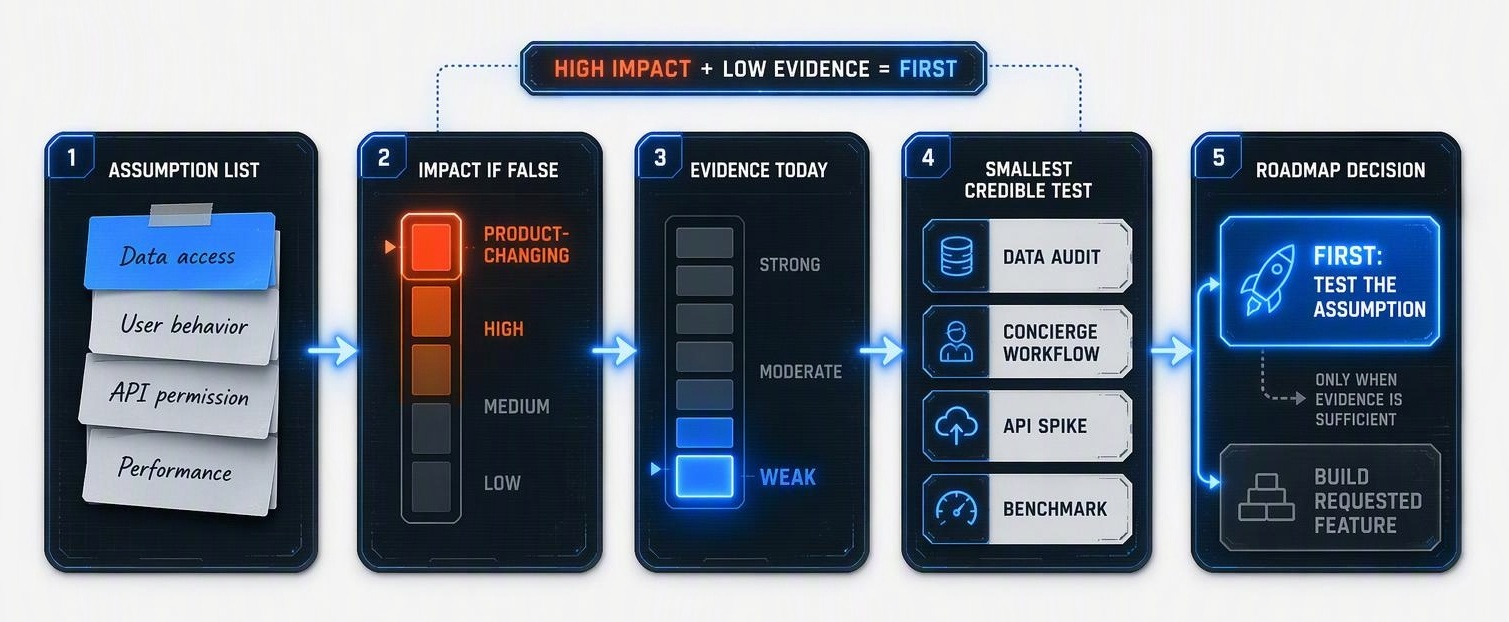
Rank assumptions by their impact if false and the strength of the evidence available today. An assumption with a large consequence and little evidence belongs near the top of the roadmap, even if it does not resemble a customer-facing feature.
Add one practical check: how quickly and cheaply can the team obtain a credible answer? The question becomes: which unanswered condition would most change the plan if it failed? A technical spike, data audit, prototype, concierge test, or partner permission check may answer that question faster than a production build.
A requested feature can still be the right next item when its underlying assumptions are already supported. The corrective is not to treat all features as unimportant. It is to stop giving low-uncertainty work automatic priority just because it is easier to demonstrate.
What should you build to get evidence without overbuilding
Early validation work should produce a credible answer with the smallest responsible commitment. Manually assemble the needed data before automating ingestion. Test an API permission in a disposable integration before designing an entire partner workflow. Run the critical customer task with a small group before building every supporting screen.
The same rule applies to engineering constraints. Benchmark the difficult technical path before architecture hardens around an untested performance assumption. If the result is disappointing, the team has learned while its options are still open.
Not every uncertainty requires a formal experiment. But every product-invalidating uncertainty needs evidence proportionate to the investment it unlocks. A narrow test that prevents months of misdirected delivery is roadmap work, not overhead.
Feature delivery proves that work was completed. Learning delivery proves whether the product direction remains viable. Easy-to-demo work can create sunk cost, making a later change feel harder than it should. Success is not the number of features completed, it is whether the next investment is being made with the uncertainty that could overturn it already reduced.